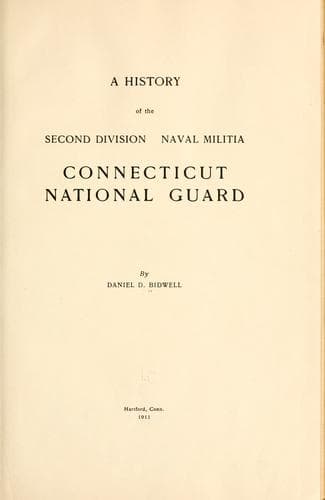
A History of the Second Division Naval Militia Connecticut National GuardBidwell, Daniel Doane
History
A History of the Second Division Naval Militia Connecticut National Guard
Bidwell, Daniel Doane
Connecticut. Militia
Sunday found the ship off Block Island and Monday evening found her
heading north. Just as the watch off duty was beginning to snore
peacefully, the bugle sounded the call for general quarters. In a moment
the gun deck lights were switched on and ladders and hatches were choked
with men piling to their stations. Masters-at-arms were unceremoniously
rousting out rookies from their hammocks. In barely more time that it
has taken to write this paragraph the guns were cast loose, ammunition
was provided and the big naval bulldog was in fighting trim.
One afternoon the battalion had boat drill. Cutters were lowered and
with boat guns working and the landing party armed with rifles there was
a pretty bit of excitement. A day later the heavy guns belched at a
signal station ashore, which crumbled to theoretic dust. Then the naval
militiamen were mustered at division quarters and a day’s ration was
issued to each man, a two-pound tin of canned beef to each pair of men
and five or ten hard tack (or ship biscuit) to each man and a canteen
full of water or coffee, as the man elected. The call came for arm and
away boats. With a Colt automatic in the bow of each cutter the party
landed, going into extended order, while a detail took possession of the
telegraph and the telephone station.
The long line of blue swarmed over a strip of sand and a bit of swale to
a knoll. Then began two hours’ hard work. Through wire grass and sand
grass, through bushes and brush, across swamp and swale, by farmhouses
and barns, alongside lily ponds, the bending blue line advanced,
officers pointing the way with swords and squad leaders attempting to
keep the files at eight pace intervals.
Following an advance of four miles in such manner the “enemy” was
located behind the crest of a steep and high hill. The order for a
charge was given and with a yell the men sprinted forward under a heavy
shower of fireworks. Ensign Northam was the first up San Juan Hill and
it was reported that the historian was the last to reach the summit.
At this juncture the heavens opened and rain came down in buckets. After
a quarter of an hour in the downpour the battalion started on the return
of four miles. The hike was at route step. At the beach the oarsmen had
a stiff pull against wind and tide in boats loaded to the gunwales. But
the young salts were in fine spirits and when the order came to “shift
to anything dry” it was received as a joke.
The chief boatswain’s mate of the Panther was C. K. Claussen, the
Claussen who accompanied Hobson on the Merrimac and was confined in the
Spanish prison near Santiago.
At the end of the week, when the Panther left the squadron, her course
lay between the Olympia, Dewey’s flagship in the Battle of Manila Bay,
and the Brooklyn, Schley’s in the capture of Cervera. To each was given
a salute with the bugle and the lining of the rail. The Brooklyn’s band
rendered a patriotic air.
Public-domain text, read in full here on John Shaqi.
Reviews
Reviews
No reviews yet
Be the first to share your thoughts on this work.
Join the Discussion
Join the discussion
Sign in to leave a comment or review.
Sign InorCreate an account