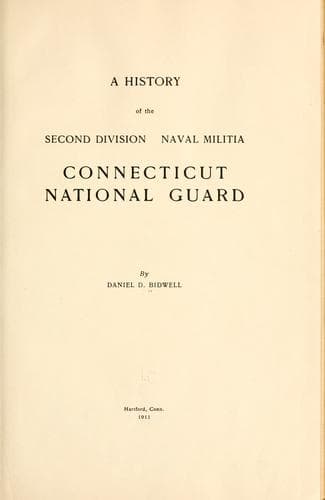
A History of the Second Division Naval Militia Connecticut National Guard — John Shaqi
A History of the Second Division Naval Militia Connecticut National GuardBidwell, Daniel Doane
History
A History of the Second Division Naval Militia Connecticut National Guard
Bidwell, Daniel Doane
Connecticut. Militia
The Elfrida steamed out of the bay as the storm was breaking, on her way
to Sandy Hook and the yacht races with Governor Chamberlain on board.
The sou’wester rose into a gale. Seas broke high over the weather rail
to fly across the engine room skylight. The officers on the bridge and
the quartermaster on watch were soon soaked to the skin in spite of
oilskins and pea coats. It was a fierce night and the brave little ship
had a nervy tussle with the gale. At 3 o’clock in the morning the
Elfrida put into Huntington Bay and dropped anchor, finding that five
large steamers were there riding out the night, among them the Tremont
of the Joy Line, and the Shinnecock. Stormbound sailing craft were also
in the bay.
Soon after the hook went down it was found to be dragging, then the ship
was taken farther inshore and both starboard and port anchors were let
drop, with a good length of cable.
Later a distress sign was sighted on a yacht out in the open water. A
volunteer boat crew pulled out and found the vessel to be the schooner
Rosina, from New Haven, owned by an amateur who had a sailing master,
three women and a cook on board. The owner seasick, the sailing master
called the cook for a moment to the wheel, while he stepped down into
the cabin for a chart. The cook lost his head and, while in the wind,
the schooner’s main-topmast snapped and her fore-topsail carried away.
The rescuing boat crew found the women hysterical and with life
preservers adjusted. The men from the Elfrida cleared away the wreckage.
Early in the fall the division entertained members of H Company, Naval
Brigade, M. V. M., of Springfield, at Camp Parker with an old-time shore
clambake. The camp had become increasingly popular and for a number of
years nearly every Saturday or Sunday afternoon in midsummer attracted
division men to the place, and in “whites” the boys kept busy making
things snug in the galley or policing the grounds or taking a spin in a
pulling boat below.
November 18 brought an extraordinary spectacle—a book bee. At our bell
in the first watch, Librarian Palmer and Jack-o’-the-Shelf McDonald
broke out their accessioning system and the smoking lamp was lighted.
The books given made a startling list. Tolstoy’s “Resurrection” was
found sandwiched between “Alice in Wonderland” and a volume of
Lighthouse Reports. General Miles, Kipling, Morgan Robertson and
Roosevelt were popular authors. This is history, not romance. An
entertainment followed the book bee. Clog dancing on the foc’s’le head,
nautical songs, selections on cordage and dead eyes by a banjo quintet
and a sword dance by Coxswain Watson made up the backbone of the
evening. It was seven bells when the rejoicing ceased and the
merrymakers heaved out of the armory, all on soundings and under easy
canvas, except the supposed contributor of “Resurrection,” who scudded
away under a double-reefed fore-topsail.
Public-domain text, read in full here on John Shaqi.
Reviews
Reviews
No reviews yet
Be the first to share your thoughts on this work.
Join the Discussion
Join the discussion
Sign in to leave a comment or review.
Sign InorCreate an account