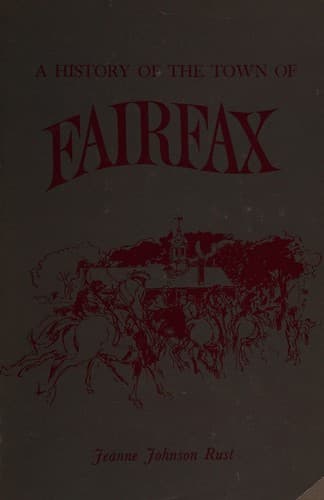
A History of the Town of FairfaxRust, Jeanne Johnson
History
A History of the Town of Fairfax
Rust, Jeanne Johnson
Fairfax (Va.) -- History
This road is now locally known as the old Braddock Road, named after
General Braddock who presumably traversed it on his way to Ft.
Duquesne. Although historians disagree on the authenticity of this
route being taken by Braddock, around the road has grown a legend of
"buried treasure".
The story goes that the road was impassable and the weather
extremely inclement when Braddock and his men used it. They had to
cut down trees and other growth to clear their way. Added to this
was the fact that they were carrying a chest of gold coins, with
which to pay the men. They had two cannons, which were proving
extremely burdensome, and were constantly becoming bogged down in
the mud.
Finally, having lost so much time due to the condition of the road
and the heaviness of his cannons and gold, Braddock decided to
lighten his load. Taking the gold coins, he stuffed the nozzles of
both cannons with the coins and then buried the cannons near a
spring on the road near Centreville. The story continues that the
spring has since dried up and although many people, including the
British, have searched for years for the "buried treasure", it has
never been found.
Near the intersection of Ox Road and Braddock Road was a tract of
land (the future site of George Mason College, the northern Virginia
branch of the University of Virginia) which was owned by the Farr
family. The large home on this tract of land was burned by Union
forces during the Civil War in retaliation for a very brave act by
the young fourteen year old Farr boy.
This young boy, knowing that Union troops were located at Fairfax
Station waiting to attack the Court House, built a road block of
logs across the Ox Road over which these troops had to pass. Hiding
himself in the underbrush nearby, he fired so heroically upon the
enemy troops, as they approached, that they assumed there was a
large group of Confederates waiting for them and withdrew to Fairfax
Station. When they learned of the hoax, they returned and burned the
Farr home to the ground.
[Illustration]
V. THE TOWN
Historically, the most important house in the town of Fairfax is the
Ratcliffe-Logan-Allison House at 10386 Main Street. This little
brick house was built in 1805 when the town was founded and the
original half meets the specifications of the 1805 Virginia State
Legislature. It is sixteen feet square, has a brick chimney, and is
"fit for habitation." The Ratcliffe-Logan-Allison House is
considered to be in "pristine" form and unchanged from its original
condition except for an 1830 addition which is believed to have been
built by the same brick mason.[1]
[1] _The Richard-Ratcliffe-Allison House is listed on the Virginia
Historic Landmarks Register and on the National Register of
Historical Places. It belongs to the City of Fairfax and is an
integral part of the founding of the town._
Public-domain text, read in full here on John Shaqi.
Reviews
Reviews
No reviews yet
Be the first to share your thoughts on this work.
Join the Discussion
Join the discussion
Sign in to leave a comment or review.
Sign InorCreate an account