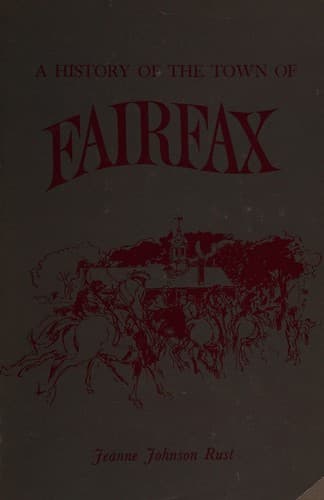
A History of the Town of FairfaxRust, Jeanne Johnson
History
A History of the Town of Fairfax
Rust, Jeanne Johnson
Fairfax (Va.) -- History
While the rich progressed from rough shacks to Georgian homes, there
was no such advance for the poor. There was not even any improvement
in agricultural implements and the poor were finding it more and
more difficult to compete with the large landholders and their
scores of slaves.
They resented the tight band held over them by the mother country,
who, they felt, neither understood their problems nor how to cope
with them, as well as they did (e.g., the impractical way the
English tried to fight the Indians during the French-Indian war).
[Illustration]
Added to this was the constant pressure from the mother country for
more money to exploit her domain, felt in the enforcement of the
"Sugar Act", "Stamp Act", "Tea Act", and "Boston Port Act".
The smoldering embers of hate began to flare in the hearts of the
radicals. The gentry hoped to keep the radicals under control for
they felt the Virginia colony had less cause to fight than the other
colonies. The colony of which they were a part was "the most
populous, prosperous and important one of the thirteen." They had
not felt the sting of taxes like their northern mercantile brothers
nor the sting of poverty like their less fortunate southern
brothers.
For example, when the "Stamp Act" was being considered. Richard
Henry Lee applied for the position of stamp distributor. When a
fight developed in the House concerning the "Stamp Act", Peyton
Randolph, Edmund Pendleton, Richard Bland and George Wythe opposed
Patrick Henry's resolutions bitterly.
The gentry in Fairfax seemed to be the exception for George
Johnston, a prominent lawyer living between Alexandria and Mt.
Vernon, backed Patrick Henry in his protest. George Mason wrote the
Non-importation Resolutions in 1769, his Fairfax Resolves in 1774
and his famous Bill of Rights in 1776. George Washington, Fairfax
planter, was, of course, Commander in Chief of the Continental Army
and brought the country through to victory under the most difficult
circumstances.
Large numbers of able-bodied citizens in the County served under
Washington in the Revolution. An artillery company was formed out
of the two militia companies in Fairfax and two later drafts took
eighty-two more men. There were a few English sympathizers like the
Fairfax family who did not take part but almost every influential
family in the County fought on the side of Independence.
During this time Patrick Henry served as Governor of the
Commonwealth of Virginia, and in this capacity, appointed a Sheriff
to serve the County of Fairfax. One of the most interesting
documents in view at the Fairfax County Clerk's Office is the
original of this command signed by P. Henry.
The County itself was touched by battle on two occasions: (1) The
Continental Army under General Lafayette crossed the Potomac near
Chain Bridge and (2) Rochambeau's Army of French allies came up
through the County over the old King's Highway to Alexandria, where
French transports awaited them.
Public-domain text, read in full here on John Shaqi.
Reviews
Reviews
No reviews yet
Be the first to share your thoughts on this work.
Join the Discussion
Join the discussion
Sign in to leave a comment or review.
Sign InorCreate an account