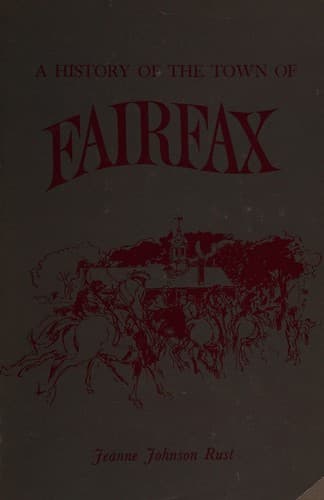
A History of the Town of FairfaxRust, Jeanne Johnson
History
A History of the Town of Fairfax
Rust, Jeanne Johnson
Fairfax (Va.) -- History
During the time that the Union Army occupied Fairfax a group of
Blenkers Dutch held the court house in the spring or autumn of 1862.
They had been recruited in Pennsylvania from the most ignorant and
reckless German characters and could not understand a word of
English.
Due to the Blenkers Dutch, many important papers at the court house
were stolen or destroyed. These men broke open the safe and used
wills, deeds, or anything that came into their hands to keep their
fires going. It was only by luck that the will of Martha Washington
was saved.
A Lt. Col. Thompson who was in command walked in on the men burning
papers and made them stop. Reaching down to see what they were
burning, he picked out a paper at random. Finding it to be the will
of Martha Washington, he put it in his pocket and either mailed it
to his daughter or gave it to her after he returned home.
[Illustration]
Years later the people of Fairfax learned that the will had been
sold by Miss Thompson to J. P. Morgan and they set out to recover
it. In the Fairfax County Historical Society Year Book, 1952-53, is
an interesting account of the correspondence between Mr. Morgan's
son and the citizens of the Town, the Governor of Virginia, and
others. The will now rests beside that of George Washington in a
glass enclosed case in the Clerk's Office of Fairfax Court House.
It is also well known that Washington's will barely escaped being
burned in the fire at Richmond, where it had been sent for safe
keeping. When Union forces took possession of Richmond, they went to
the state library and scattered papers all over the floor, taking
what they wanted. They overlooked Washington's will, however, and
Mr. Lewis, who was Secretary of the Commonwealth, picked it up and
kept it until after the war, when Mr. O. W. Huntt was sent by the
County of Fairfax to Richmond to retrieve the will.
Later on, at the Centennial, copies of Washington's will were
evidently sold amidst much criticism from a metropolitan newspaper,
for we find a letter from Mr. Richardson, Clerk of the Court,
explaining--
"Mr. Andrew Jackson some years ago being a resident of this place
made a complete copy of the will (Washington's) and had it certified
by the Clerk and published as such. He was assisted in this by the
Honorable W. W. Corcoran of Washington, D. C., and these are the
copies sold at the Centennial."
[Illustration]
XII. RECONSTRUCTION
As the reconstruction period came after the war, Fairfax found
herself in a very destitute position. Most of her churches had been
burned, her fields destroyed by constant skirmishes, her homes used
as headquarters or hospitals by Union soldiers. The Willcoxon
Tavern, Duncan's Chapel and doubtless other places had been used as
stables for Union horses. Deflation closed in; the people again
found themselves having to "pick up the pieces".
Public-domain text, read in full here on John Shaqi.
Reviews
Reviews
No reviews yet
Be the first to share your thoughts on this work.
Join the Discussion
Join the discussion
Sign in to leave a comment or review.
Sign InorCreate an account