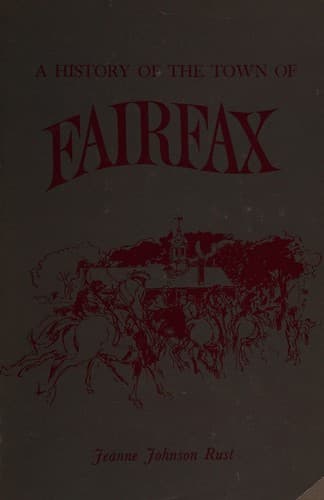
A History of the Town of FairfaxRust, Jeanne Johnson
History
A History of the Town of Fairfax
Rust, Jeanne Johnson
Fairfax (Va.) -- History
Most of these men were not ready to make their homes here, however,
for this area was still infested with unfriendly Indians. Instead
they hired indentured slaves who came from England, Scotland,
Ireland, France, etc., who worked the land for a few years, earned
their freedom and then became land owners in their own right. It
stands to reason, therefore, that the society of the Fairfax County
area at that time was necessarily crude. These indentures, though
vigorous and having outstanding individuals among them, had the
reputation of not being given to the amenities. Unfortunately, the
men in well established areas south of the indentures did not have a
realistic understanding either of the struggles and trials of these
men who were pioneering the Indian infested areas farther north.
This lack of understanding led to dissension and, in some instances,
rebellion.
[Illustration]
II. REBELLION
When the wealthy land-owners of the southern part of the colonized
area started buying up land in lower Fairfax County for speculation,
they did not buy out the title of the Doeg Indians, who occupied
this area at that time. (The white man established no relations with
the Doeg except to hold him off whenever possible). A series of
murders were committed on the frontier by Doegs and in retaliation
the colonists mistakenly killed Indians who were not Doegs. By 1675,
through a series of hot-headed misunderstandings the Susquehannock
Indians became involved and they struck whenever and wherever they
could. Captain John Smith described the Susquehannocks as having
booming voices, being seven feet tall and treading on the earth with
much pride, contempt and disdain.
Although no records were kept at the time, we can assume that many
homes were burned, women and children killed, etc. It is a known
fact that thirty-six people were killed on the Rappahannock in one
raid and that Indian retaliations of one nature or another caused
the English settlements that had reached Hunting Creek to recede to
Aquia, where they stayed for the next ten years.
Sir William Berkeley in order to help the frontiersmen, unwisely,
and at great expense to the people, commanded a fort to be built at
the mouth of each head river; e.g., one was built at Colchester on
the Occoquan. These forts proved of no value, being made of mud and
dirt. Other precarious forts were built in place of the mud ones.
These proved useless too and the governor and gentry declined to do
more.
Public-domain text, read in full here on John Shaqi.
Reviews
Reviews
No reviews yet
Be the first to share your thoughts on this work.
Join the Discussion
Join the discussion
Sign in to leave a comment or review.
Sign InorCreate an account