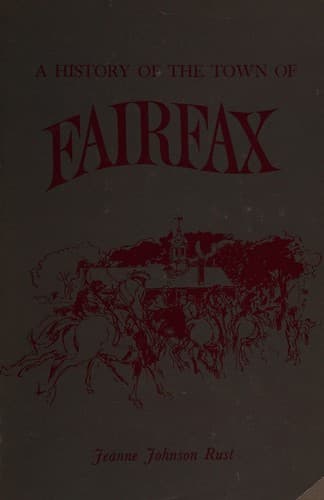
A History of the Town of FairfaxRust, Jeanne Johnson
History
A History of the Town of Fairfax
Rust, Jeanne Johnson
Fairfax (Va.) -- History
They received credit for burning many warehouses, private homes,
public buildings, churches and finally the Capitol itself in
Williamsburg. Arson became epidemic in the Northern Neck.
All legislative efforts to abort this infiltration by convicts were
stopped by the "greedy planter" who loved the cheapness of this
labor and the practice of importation survived the Revolution.
Consequently, this area was comprised of gentry, indentures,
convicts and slaves. Yet the homes of the former two were similar in
many ways. Their houses were made of wood; their roofs were made of
oak shingles. The walls were made of clapboard sealed on the inside
with mortar made of oyster shell lime which gave the room a look of
antiquated whiteness. Some houses were constructed of bricks made by
the colonists themselves. Most houses consisted of only two rooms
and several closets on the ground floor with two prophets chambers
above. They built separate houses for the kitchen, for Christian
servants, for Negro slaves, and several for curing tobacco. Each
household gave the appearance of a small village. There were no
stables. Cattle and horses were allowed to run in the woods.
Merchandise was supplied by traveling salesmen from England who took
their loaded ships from creek to creek.
Due to the fact that most people lived on widely separated
plantations there were very few schools. Sometimes a house was
erected on one of the old fields which had outlived its usefulness
and there the children of the plantation owner along with those of
relatives and neighbors would attend school under the supervision of
a tutor hired by the main family. These were called "Old Field
Schools". They were made of logs held together by wooden pins. The
roof was shingled with hand-hewn wood shingles and a large field
stone fireplace was used to heat the room. There were few books
available and the tiresome methods of teaching were heavily
interspersed with strict discipline. School began at eight o'clock
in the morning and a recess was taken at eleven. It opened again at
one o'clock and closed at four o'clock in the afternoon.
Public school systems did not make their appearance until 1857. As a
rule, the parish halls of the various churches were used to house
the students.
The children of the poor learned from their parents the art of
working in the fields. The wealthier families sent their eldest son
to England to be educated and other sons were educated at the
College of William and Mary which had been established in 1693.
Public-domain text, read in full here on John Shaqi.
Reviews
Reviews
No reviews yet
Be the first to share your thoughts on this work.
Join the Discussion
Join the discussion
Sign in to leave a comment or review.
Sign InorCreate an account