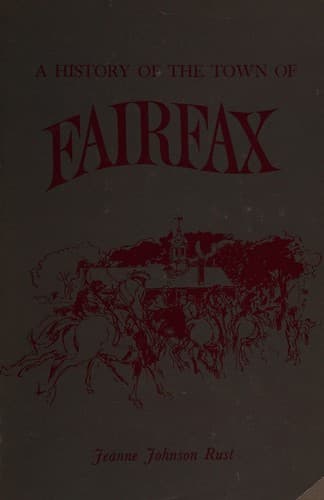
A History of the Town of FairfaxRust, Jeanne Johnson
History
A History of the Town of Fairfax
Rust, Jeanne Johnson
Fairfax (Va.) -- History
FOR the greater ease and convenience of the inhabitants of the
county of Prince William, in attending courts, and other public
meetings, Be it enacted by the Lieutenant Governor, Council and
Burgesses, of this present General Assembly, and it is hereby
enacted by the Authority of the same. That from and immediately
after the first day of December now next ensuing, the said county of
Prince William shall be divided into two counties: That is to say,
all that part thereof, lying on the south side of Occoquan and Bull
Run; and from the head of the main branch of Bull Run, by a straight
course to the Thorough-fare of the Blue Ridge of mountains, known by
the name of Ashby's Gap, or Bent, shall be one distinct county, and
retain the name of Prince William county: And be one distinct
parish, and retain the name of Hamilton parish. And all that other
part thereof, consisting of the parish of Truro, shall be one other
distinct county, and called and known by the name of Fairfax
county.... And a court for the said county of Fairfax, be constantly
held by the justices of that county, upon the third Thursday in
every month, in such manner, as by the laws of this colony is
provided, and shall lie by their commissions directed.]
As people followed this road inward to seat land, a new parish was
set up which was named "Truro" by King Carter. He expected the
parish to be a mining district and named it after a borough of
Cornwall, England, which was a shipping port for tin and copper ore.
Truro tried to provide meeting places for all and called upon a man
by the name of Samuel Littlejohn, who seated land south of the
future site of the Town of Fairfax, for help in supplying a place to
worship for this particular area. Mr. Littlejohn complied by renting
his tobacco barn for regular services.
He received 1000 lbs. of tobacco a year for its rent. The barn was
fitted with six benches which ran the length of the house and two
benches which stood at each end of the building. A Communion table
and a reading desk with a small window on each side of the desk
concluded the specified alterations. This was in 1765. The exact
location of this barn has not been identified but it seems likely
that it was in the vicinity of Edward Payne's home on middle ridge
near the Ox road, where Payne's church was built in 1766. (The
Virginia Army National Guard Nike Site is now located on part of
Payne's land.)
Public-domain text, read in full here on John Shaqi.
Reviews
Reviews
No reviews yet
Be the first to share your thoughts on this work.
Join the Discussion
Join the discussion
Sign in to leave a comment or review.
Sign InorCreate an account