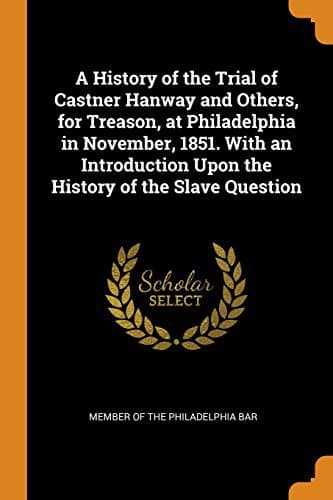
A History of the Trial of Castner Hanway and Others, for Treason, at Philadelphia in November, 1851: With an Introduction upon the History of the Slave QuestionMember of the Philadelphia bar
History
A History of the Trial of Castner Hanway and Others, for Treason, at Philadelphia in November, 1851: With an Introduction upon the History of the Slave Question
Member of the Philadelphia bar
Fugitive slaves -- Legal status, laws, etc. -- United States; Hanway, Castner, 1821-1893 -- Trials, litigation, etc.; Riots -- Pennsylvania -- Christiana; Trials (Treason) -- Pennsylvania -- Philadelphia; United States -- Fugitive slave law (1850)
calling out, “Peace, peace,” however discordant the answer may be;
and who, if they needs must fight, would be glad to know what they’re
fighting about, fight in earnest and be done with it. To answer, then,
at least one of these questions, and suggest to this rapidly increasing
class precisely what the present phase of the battle is, and what hopes
there are of final peace, this brief historical sketch is attempted.
The purpose is not, we repeat it, to discuss the subject; the author
aims not at the dignity of a disputant; he is more than satisfied with
the humbler task of supplying materials for those who do,--in hopes
that if rage and anger have hitherto filled the place of armorers in
our battle-field, history may in future discharge the duty a little
more creditably. It is proposed, then, to trace the slavery question
at length, so far as it has been the source of national difficulties,
embarrassments and legislation, with especial reference to its earlier
history, and to the clause in the Constitution respecting fugitives,
which has lately been made the subject of Congressional action.
It will not be necessary to extend our inquiries to any period anterior
to the revolution, or in any way to examine the peculiar causes which
first established and have long perpetuated slavery amongst us. Prior
to that event, it was of course a question between Great Britain and
her colonies, and nice casuistry might perhaps be needed to determine
the relative amount of guilt chargeable on each of the two parties. The
moral value, too, of a solemn judicial decision, “that no slave could
breathe the air or stand on the free soil of England,” may be a little
questioned, when it is remembered that such property would of necessity
be almost worthless in her climate; and that at the very moment when a
reluctant Judge pronounced these boasted words, her capitalists were
rolling in wealth that grew out of the sweat on negro brows in her
American plantations. We have heard of high bred Southern families in
which a thousand out-door slaves are never suffered to pollute the
pure air of the saloons and chambers that their masters breathe, or
tread the rich carpets that their toil has paid for. The custom is
undoubtedly refined and agreeable, but we never heard that it boasted
to rest on higher grounds than ordinary mortals venture on.
Public-domain text, read in full here on John Shaqi.
Reviews
Reviews
No reviews yet
Be the first to share your thoughts on this work.
Join the Discussion
Join the discussion
Sign in to leave a comment or review.
Sign InorCreate an account