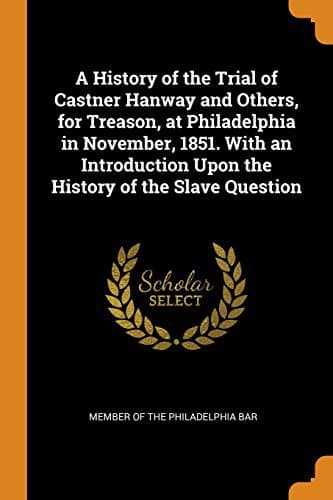
A History of the Trial of Castner Hanway and Others, for Treason, at Philadelphia in November, 1851: With an Introduction upon the History of the Slave QuestionMember of the Philadelphia bar
History
A History of the Trial of Castner Hanway and Others, for Treason, at Philadelphia in November, 1851: With an Introduction upon the History of the Slave Question
Member of the Philadelphia bar
Fugitive slaves -- Legal status, laws, etc. -- United States; Hanway, Castner, 1821-1893 -- Trials, litigation, etc.; Riots -- Pennsylvania -- Christiana; Trials (Treason) -- Pennsylvania -- Philadelphia; United States -- Fugitive slave law (1850)
On the morning in question, a colored man living in the neighborhood,
who was passing Parker’s house at an early hour, saw the yard full of
men. He halted, and was met by a man who presented a pistol at him, and
ordered him to leave the place. He went away and hastened over to the
store kept by Elijah Lewis, which, like all places of that kind, was
probably the headquarters of news in the neighborhood. Mr. Lewis was
in the act of opening his store when this man told him that “Parker’s
house was surrounded by _kidnappers_, who had broken into the house,
and _were trying to get him away_.” Lewis, not questioning the truth of
the statement, repaired immediately to the place. On the way he passed
Castner Hanway’s house, and telling him what he had heard, asked him to
go over to Parker’s house. Hanway was in feeble health and unable to
undergo the fatigue of walking that distance. He saddled his horse, and
reached Parker’s during the armistice.
Having no reason to believe he was acting under legal authority, when
Kline approached and demanded assistance in making the arrests, Hanway
made him no answer. Kline then handed him the warrants, which Hanway
examined, saw they appeared genuine, and returned them.
At this time, several colored men, who no doubt had heard the report
that kidnappers were about, came up, armed with such weapons as they
could suddenly lay hands upon. How many there were on the ground during
the affray it is _now_ impossible to determine. The witnesses on both
sides vary materially in their estimate. Some said they saw a dozen
or fifteen; some, thirty or forty; and others maintained, as many as
two or three hundred. It is known there were not two hundred colored
men to be found within eight miles of Parker’s house, nor half that
number within four miles, and it would have been almost impossible to
get together even thirty at an hour’s notice. It is probable there were
about twenty-five, all told, at or near the house from the beginning
of the affray until all was quiet again. These the fears of those who
afterwards testified to larger numbers, might easily have magnified to
fifty or a hundred.
While Kline and Hanway were in conversation, Elijah Lewis came up.
Hanway said to him, “Here is the marshal.” Lewis asked to see his
authority, and Kline handed him one of the warrants. When he saw the
signature of the U. S. Commissioner, “he took it for granted that
Kline had authority.” Kline then ordered Hanway and Lewis to assist
in arresting the alleged fugitives. Hanway refused to have anything
to do with it. The negroes around these three men seeming disposed to
make an attack, Hanway “motioned to them and urged them back.” He then
“advised Kline that it would be dangerous to attempt making arrests,
and that they had better leave.” Kline, after saying he would hold them
accountable for the negroes, promised to leave, and beckoned two or
three times to his men to retire.
Public-domain text, read in full here on John Shaqi.
Reviews
Reviews
No reviews yet
Be the first to share your thoughts on this work.
Join the Discussion
Join the discussion
Sign in to leave a comment or review.
Sign InorCreate an account