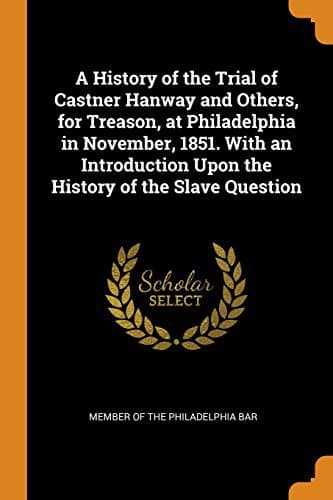
A History of the Trial of Castner Hanway and Others, for Treason, at Philadelphia in November, 1851: With an Introduction upon the History of the Slave QuestionMember of the Philadelphia bar
History
A History of the Trial of Castner Hanway and Others, for Treason, at Philadelphia in November, 1851: With an Introduction upon the History of the Slave Question
Member of the Philadelphia bar
Fugitive slaves -- Legal status, laws, etc. -- United States; Hanway, Castner, 1821-1893 -- Trials, litigation, etc.; Riots -- Pennsylvania -- Christiana; Trials (Treason) -- Pennsylvania -- Philadelphia; United States -- Fugitive slave law (1850)
The first of these was rightly regarded at the time, as by far the
most important, not only because of the magnitude of the interests
directly involved in its decision, but still more so, because of
the principles which, though scarcely remembered at present, were
undoubtedly the basis of the Compromise, in which the deliberations
of the convention resulted. A moment’s reference to the slave census,
referred to above, will show how great was the contrariety of interests
involved, and give a tolerably correct idea of the influences by
which the various States were governed in discussing the subject. For
whatever pleasure it might give us to conceal the humiliating fact,
candor will compel us to acknowledge, that even in those heroic times
of our history, interest seldom gave way to any nobler feeling when a
question like this was to be determined. The original claim set up by
the South but abandoned upon the final vote--except by South Carolina,
Georgia, and Delaware--was that the black population should be as
largely represented in Congress, as the white. It is impossible to
give anything but a very brief outline of the arguments used upon both
sides. Without venturing to insist upon the obvious absurdity, that
an enslaved and helpless race were really entitled to representation
because of any rights _they_ themselves might have to defend or duties
which they might be bound to discharge, the Southern members took the
position, not regarded at that time as utterly heterodox, that a State
is entitled to be represented, not merely because of its containing
so many human beings, but because so many human beings are in reality
only the exponent of so much wealth or so much power contributed by
such State to the support of the general government. The federal value
of the State is in direct proportion to the amount of this power, and
what difference could it make whether it emanated as in the South from
a race called slaves, supported at the direct expense of their masters,
who supplied them liberally with all the necessaries of life; or as
in the North, from a population occupying precisely the same relative
position in the social scale, performing labor of the same description,
maintained, though in a somewhat different way by the same capitalist,
and called Freeman--if one were entitled to representation, why not
the other? The negro population was as essentially a producing power
and as original an element of wealth as any body of free laborers could
be, and therefore as fully entitled to have their interests consulted
in the proceedings of a Government instituted for the express purpose
of providing for the security of property. But in addition to this,
they were entitled to make this claim not only as producers, but also
as consumers of those foreign productions, the importation of which
would form one great element of wealth in the Eastern States.
Reviews
Reviews
No reviews yet
Be the first to share your thoughts on this work.
Join the Discussion
Join the discussion
Sign in to leave a comment or review.
Sign InorCreate an account