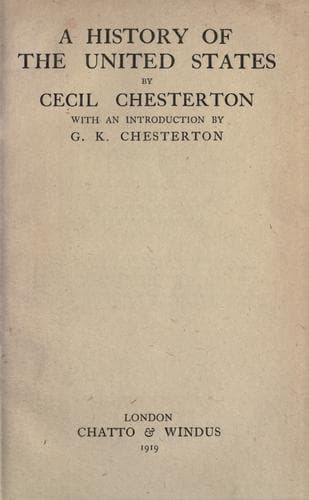
The author of this book, my brother, died in a French military hospital
of the effects of exposure in the last fierce fighting that broke the
Prussian power over Christendom; fighting for which he had volunteered
after being invalided home. Any notes I can jot down about him must
necessarily seem jerky and incongruous; for in such a relation memory is
a medley of generalisation and detail, not to be uttered in words. One
thing at least may fitly be said here. Before he died he did at least
two things that he desired. One may seem much greater than the other;
but he would not have shrunk from naming them together. He saw the end
of an empire that was the nightmare of the nations; but I believe it
pleased him almost as much that he had been able, often in the intervals
of bitter warfare and by the aid of a brilliant memory, to put together
these pages on the history, so necessary and so strangely neglected, of
the great democracy which he never patronised, which he not only loved
but honoured.
Cecil Edward Chesterton was born on November 12, 1879; and there is a
special if a secondary sense in which we may use the phrase that he was
born a fighter. It may seem in some sad fashion a flippancy to say that
he argued from his very cradle. It is certainly, in the same sad
fashion, a comfort, to remember one truth about our relations: that we
perpetually argued and that we never quarrelled. In a sense it was the
psychological truth, I fancy, that we never quarrelled because we always
argued. His lucidity and love of truth kept things so much on the level
of logic, that the rest of our relations remained, thank God, in solid
sympathy; long before that later time when, in substance, our argument
had become an agreement. Nor, I think, was the process valueless; for
at least we learnt how to argue in defence of our agreement. But the
retrospect is only worth a thought now, because it illustrates a duality
which seemed to him, and is, very simple; but to many is baffling in its
very simplicity. When I say his weapon was logic, it will be currently
confused with formality or even frigidity: a silly superstition always
pictures the logician as a pale-faced prig. He was a living proof, a
very living proof, that the precise contrary is the case. In fact it is
generally the warmer and more sanguine sort of man who has an appetite
for abstract definitions and even abstract distinctions. He had all the
debating dexterity of a genial and generous man like Charles Fox. He
could command that more than legal clarity and closeness which really
marked the legal arguments of a genial and generous man like Danton. In
his wonderfully courageous public speaking, he rather preferred being a
debator to being an orator; in a sense he maintained that no man had a
right to be an orator without first being a debater. Eloquence, he said,
had its proper place when reason had proved a thing to be right, and it
was necessary to give men the courage to do what was right. I think he
Public-domain text, read in full here on John Shaqi.
Reviews
Reviews
No reviews yet
Be the first to share your thoughts on this work.
Join the Discussion
Join the discussion
Sign in to leave a comment or review.
Sign InorCreate an account