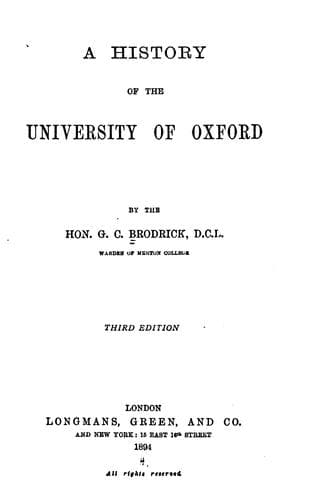
A history of the University of Oxford — John Shaqi
A history of the University of OxfordBrodrick, George C. (George Charles)
History
A history of the University of Oxford
Brodrick, George C. (George Charles)
University of Oxford -- History
Oxford was, after Paris, ‘_schola secunda ecclesiæ_.’
FOOTNOTES:
[1] It is perhaps needless to observe that ‘universitas’ signifies
a ‘corporation’ or guild, and implies no universality in the range
of subjects taught, or _Universitas Facultatum_. ‘Studium Generale’
probably signifies a place of education open to all comers.
[2] See the Introduction to Anstey’s _Munimenta Academica_, pp. xxxv.
et sqq.
CHAPTER II.
THE EARLY COLLEGES.
[Sidenote: Rise of Colleges]
By far the most important event in the academical history of the
thirteenth century was the foundation of University, Balliol, and
Merton Colleges. The idea of secular colleges, it is true, was not
wholly new. Harold’s foundation at Waltham, afterwards converted into
an abbey, was originally non-monastic, and designed to be a home
for secular priests, but it was not an educational institution.
There were colleges for the maintenance of poor scholars at Bologna;
rather, however, in the nature of the Oxford halls. If the founders
of the earliest Oxford college were indebted for their inspiration to
any foreign source, they must have derived it from the great French
University in Paris, of which the collegiate system already formed
a distinctive feature. Not to speak of still more ancient colleges
at Paris, either attached to monasteries or serving the purpose of
mere lodging-houses, the Sorbonne, founded about 1250, furnishes
a striking precedent for its Oxford successors, as an academical
cloister specially planned for the education of the secular clergy.
Nevertheless, there is no proof that its constitution was actually
imitated or studied by the founder of any Oxford college, and there
is one important difference between the Paris and Oxford colleges,
that whereas the former were appropriated to special faculties, the
latter welcomed students in all faculties. It is, therefore, by no
means improbable that in the development of the college system, as in
the original incorporation of schools into an academical body, like
causes produced like results by independent processes at the French and
English Universities.
[Sidenote: Foundation of University and Balliol]
Public-domain text, read in full here on John Shaqi.
Reviews
Reviews
No reviews yet
Be the first to share your thoughts on this work.
Join the Discussion
Join the discussion
Sign in to leave a comment or review.
Sign InorCreate an account