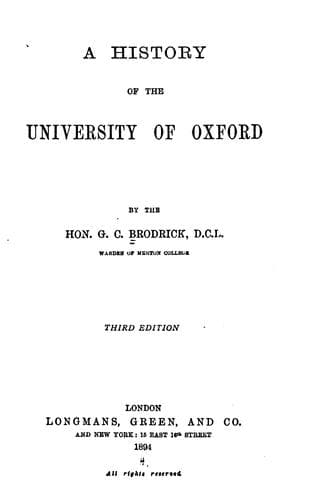
A history of the University of OxfordBrodrick, George C. (George Charles)
History
A history of the University of Oxford
Brodrick, George C. (George Charles)
University of Oxford -- History
prescribed, and if any scholars retired from the college with the
intention of giving up learning, or even ceased to study diligently,
their salaries were no longer to be paid. If the scale of these
salaries and statutable allowances was humble, it was chiefly because
the founder intended the number of his scholars to be constantly
increased, as the revenues of the house might be enlarged. He even
recognised the duty of meeting the needs of future ages, and empowered
his scholars not only to make new statutes, but even to migrate
elsewhere from Oxford in case of necessity.
[Sidenote: Social position, manners, and academical life of early
students]
If we seek to measure the effect produced by the rise of colleges on
the character of the University, we must endeavour to realise the
aspect of University life and manners before colleges were planted in
Oxford. The students, as we have seen, were lodged in religious houses,
licensed halls, or private chambers. The former were mostly destined to
swell the ranks of the regular clergy, and, it may be presumed, were
subjected to some wholesome rules of discipline, independent of any
authority exercised by the University. As they also received the whole
or the greater part of their instruction within the walls of their
convents, they probably were rarely seen in the streets, cultivated
a certain degree of refinement, and took comparatively little part
in the riots which constantly disturbed the peace of Oxford in the
Middle Ages. With the other two classes it was far otherwise. Even the
inmates of halls lived in a style and under conditions which, in our
own age, would be regarded as barbarism. Like other scholars, they were
chiefly drawn from a social grade below that of esquires or wealthy
merchants. Many of them were the less vigorous members of yeomen’s or
tradesmen’s families; not a few sprang from the very lowest ranks,
and actually begged their way to Oxford. The majority had probably
come as mere schoolboys, at the age of eleven or twelve, to one of the
numerous grammar-schools which prepared their pupils for the higher
studies taught in the ‘Schools of Oxford’ properly so called. It was
for these younger scholars, we may suppose, that regular ‘fetchers’
and ‘bringers’ were licensed by the University, as we learn from a
document of 1459, though some were attended by private servants. The
older scholars, however, doubtless travelled in parties, for the sake
of protection and economy, with their scanty baggage slung over the
backs of pack-horses. Having safely arrived in Oxford, they would
disperse to their several halls; and it does not appear that, at this
period, a freshman underwent any process of matriculation or took any
oath before acquiring the privileges of the University. He would, of
course, share his bedroom, if not his bed, with others, and be content
with the roughest fare, but he must also have dispensed with nearly all
Public-domain text, read in full here on John Shaqi.
Reviews
Reviews
No reviews yet
Be the first to share your thoughts on this work.
Join the Discussion
Join the discussion
Sign in to leave a comment or review.
Sign InorCreate an account