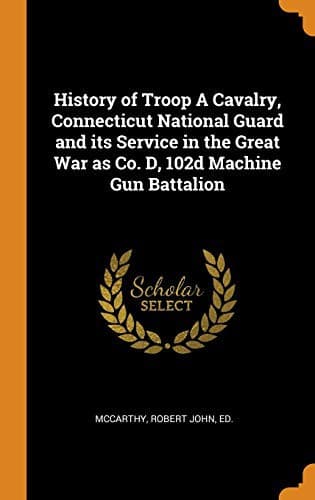
A History of Troop A Cavalry, Connecticut National Guard and Its Service in the Great War as Co. D, 102d Machine Gun Battalion
History
A History of Troop A Cavalry, Connecticut National Guard and Its Service in the Great War as Co. D, 102d Machine Gun Battalion
United States. Army. Machine Gun Battalion, 102nd. Company D; World War, 1914-1918 -- Regimental histories -- United States
Luckily the station platforms at Le Havre were covered with bales of
cotton when the Battalion arrived to entrain at 5:30 on the afternoon
of October 31, for these served as excellent beds and they were
universally utilized as such until the train was ready to leave at
midnight. The following day, with stops at Nantes and Versailles for
coffee and various halts all along the line for reasons at no time
apparent, after the manner of the French railway systems, the troop
train continued its eastward journey, passing through Chateau Thierry
and the scene of the first battle of the Marne, through Troyes, where
coffee and rum were served by French soldiers, to the destination at
Neufchateau, where the headquarters of the 26th Division were located
and about which clustered the various units of that organization during
the period of training which followed.
CHAPTER V
TRAINING
At 9 o'clock on the morning of November 2 the Battalion detrained at
Neufchateau with hungry, travel-worn men willing to unroll their packs
in any place having the slightest appearance of being a stationary
camp, but it took all their optimism to greet enthusiastically the
mud-surrounded barracks provided for the Company about three and a half
miles southeast of Neufchateau near the village of Certilleux, in the
department of the Vosges.
Surrounded as it was by hills characteristic of that part of France,
and isolated from the other units of its command, A Company developed
its community along lines approved by itself. The barracks, of which
there were four on the east side of the road and one on the opposite
side, all of that temporary type of structure manufactured in sections
and reared without much attempt at making them comfortable, were
connected with wide stone walks. The material for these walks was
brought from the hill near at hand after hours of labor which took the
kinks out of unused muscles and increased appetites, which were far
from being satisfied because of the addled condition of the supply
service then prevailing with the American Expeditionary Forces.
Three of the group of four barracks were adopted for the use of the
Company, floors were laid, bunks of heavy green wood which had to be
carried from the railroad station nearly a mile distant were gradually
put into place, the kitchen was installed in one of the barracks with
the mess hall as an adjunct and the orderly room occupying a small
space near the end of the latter. Finally the small cylindrical stoves,
the only available means of heating the barracks, were installed, three
to a building. The single barracks on the west side of the road was
fitted up for a guard house and supply room until the horses, mules and
gun carts claimed it for their own.
Public-domain text, read in full here on John Shaqi.
Reviews
Reviews
No reviews yet
Be the first to share your thoughts on this work.
Join the Discussion
Join the discussion
Sign in to leave a comment or review.
Sign InorCreate an account