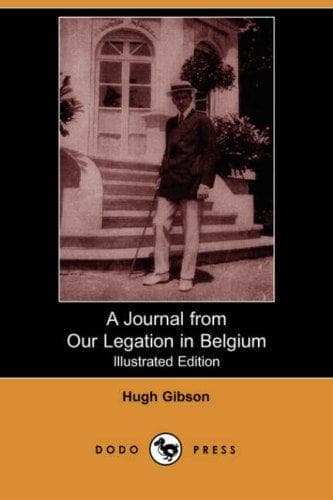
A Journal From Our Legation in BelgiumGibson, Hugh
History
A Journal From Our Legation in Belgium
Gibson, Hugh
Belgium -- History -- German occupation, 1914-1918
Presently, with a good deal of noise, a fairly large force of troops
came marching down the boulevard, and took up positions around the
station. Our officer returned, waving a smoking revolver, and told us to
lie down as flat as we could among the horses, and not to move unless
they got restive. He said it looked as though an attempt would be made
to take the station by storm, and that there might be a brisk fight.
However, there were only a few scattering shots, and then our friend
came back and told us that we had better get out and start for home
before things began again. He added, however, that we must have the
permission of the commanding officer who was on the other side of the
station, but offered to pilot us to the great man and help us get the
permission. The way lay straight out into the square, in full view of
the houses across the way, along the front of the station just behind
the troops and into the railroad yard on the other side.
That station seemed about four miles long, and the officer was possessed
of a desire to loiter by the way, recounting anecdotes of his school
days. He would walk along for a few steps and then pause to tell Bulle
some long and rambling yarn about his uncle. Bulle would take him by the
arm and get him in motion again. Then the old chap would transfer his
conversational fire to another member of the party, and we were obliged
almost to pull him the length of the square.
The commanding officer was a pleasant-faced little man who stood in the
shelter of a water tank and received us in a puzzled way, as though he
wondered what civilians were doing in that neighbourhood anyway.
Permission was readily granted for us to leave, with the ludicrous
proviso that we did so "at our own risk." Then Bulle put everybody in
good humour by inquiring innocently if there was any danger. Everybody
burst into peals of laughter, and we were escorted to our car by the
same slow-moving officer, who insisted on exchanging cards with us and
expressing the hope that we should meet again, which we could not
honestly reciprocate. Then, after an hour and a half in the station, we
got away amid a great waving of hands.
The boulevards were deserted save for the troops coming back into the
town. New houses were burning that had been intact in the afternoon.
After passing the Porte de Tirlemont, we began to see people
again--little groups that had come out into the streets through a
craving for company, and stood huddled together listening to the
fighting in the lower part of the town.
In harmony with the policy of terrorising the population, the Germans
have trained them to throw up their hands as soon as any one comes in
sight, in order to prove that they are unarmed and defenseless. And the
way they do it, the abject fear that is evident, shows that failure to
comply with the rule is not lightly punished.
Public-domain text, read in full here on John Shaqi.
Reviews
Reviews
No reviews yet
Be the first to share your thoughts on this work.
Elsewhere in the archive
Join the Discussion
Join the discussion
Sign in to leave a comment or review.
Sign InorCreate an account