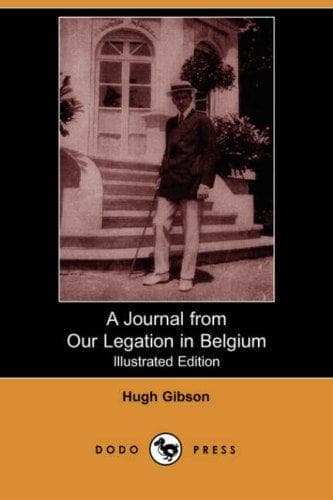
A Journal From Our Legation in BelgiumGibson, Hugh
History
A Journal From Our Legation in Belgium
Gibson, Hugh
Belgium -- History -- German occupation, 1914-1918
Our worst experience of this was when in coming around a corner we came
upon a little girl of about seven, carrying a canary in a cage. As soon
as she saw us, she threw up her hands and cried out something we did not
understand. Thinking that she wanted to stop us with a warning of some
sort, we put on the brakes and drew up beside her. Then she burst out
crying with fear, and we saw that she was in terror of her life. We
called out to reassure her, but she turned and ran like a hunted animal.
It was hard to see the fear of others--townspeople, peasants, priests,
and feeble old nuns who dropped their bundles and threw up their hands,
their eyes starting with fear. The whole thing was a nightmare.
We were dreadfully depressed, and rode along in silence until Bulle
turned around from the front seat and inquired in a matter-of-fact
voice:
"What sort of wine was that we drank at the station?"
We told him, and then he shook his head and said as though to himself:
"I drank a big glass of it, but I was so frightened that I didn't taste
it at all."
That broke the edge of the strain we were under, and we had a good laugh
in which Bulle joined.
And so back to the Legation without further mishap, to find everybody
worrying about us, and the Minister putting his foot down and announcing
that there were to be no more expeditions of the sort, no matter what
the reason for them.
* * * * *
NOTE--The foregoing is an impression of one afternoon at Louvain, taken
from a journal written at the time. It was intended to pass on the
question of responsibility for precipitating the orgy of murder and
bestiality indulged in by the German army from the 25th of August until
the 30th, when orders were received from Berlin to stop the destruction
and restore public order.
Many subsequent visits to Louvain, and conversations with people who
were there when the trouble began, have only served to strengthen the
impression that the whole affair was part of a cold-blooded and
calculated plan to terrorise the civilian population.
While we were there, it was frankly stated that the town was being wiped
out; that its destruction was being carried out under definite orders.
When the German Government realised the horror and loathing with which
the civilised world learned of the fate of Louvain, the orders were
cancelled and the story sent out that the German forces had tried to
prevent the destruction, had fought the fire, and by good fortune had
been able to save the Hotel de Ville. Never has a government lied more
brazenly. When we arrived, the destruction of the town was being carried
on in an orderly and systematic way that showed careful preparation. The
only thing that saved the Hotel de Ville was the fact that the German
troops had not progressed that far with their work when the orders were
countermanded from Berlin.
Public-domain text, read in full here on John Shaqi.
Reviews
Reviews
No reviews yet
Be the first to share your thoughts on this work.
Elsewhere in the archive
Join the Discussion
Join the discussion
Sign in to leave a comment or review.
Sign InorCreate an account