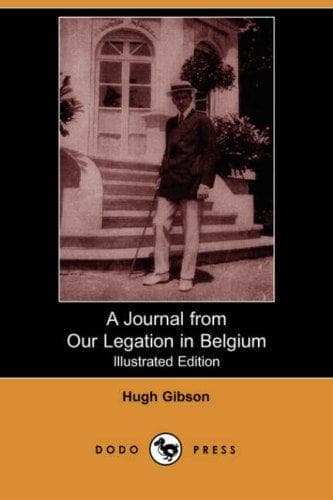
A Journal From Our Legation in BelgiumGibson, Hugh
History
A Journal From Our Legation in Belgium
Gibson, Hugh
Belgium -- History -- German occupation, 1914-1918
From Malines we made back along the northern side of the canal, in an
endeavour to find the headquarters of the ----th Division. We went
through a little village where all the inhabitants were standing in the
road, listening to the cannonading, and spun out upon an empty and
suspiciously silent country road. A little way out we found a couple of
dead horses which the thrifty peasants had already got out and skinned.
I didn't like the looks of it, and in a minute the Colonel agreed that
he thought it did not look like a road behind the lines, but our little
staff officer was cock-sure that he knew just what he was talking about,
and ordered the chauffeur to go ahead. Then we heard three sharp toots
on the horn of the car behind--the signal to stop and wait. And it came
pulling up alongside with an inquiry as to what we meant by "barging"
along this sort of a road which likely as not would land us straight
inside the enemy's lines. There was a spirited discussion as to whether
we should go ahead or go back and strike over through Rymenam, when we
heard a shell burst over the road about half a mile ahead, and then saw
a motor filled with Belgian soldiers coming back toward us full tilt.
The Colonel stopped them and learned that they had been out on a
reconnaissance with a motor-cyclist to locate the German lines, which
were found to be just beyond where the shell had burst, killing the
motor-cyclist. It would have been a little too ignominious for us to
have gone bowling straight into the lines and get taken prisoners. We
turned around and left that road to return no more that way. We got
about half-way up to Rymenam when we met some Belgian officers in a
motor, who told us that a battery of the big French howitzers, which had
just gone into action for the first time, were in a wood near H----. We
turned around once more, and made for H---- by way of Malines. We found
the headquarters of the ----th Division, and went in and watched the
news come in over the field telephone and telegraph, and by messengers
on motor-cycles, bicycles and horses straight from the field. The
headquarters was established in a little roadside inn about half a mile
outside the town, and was as orderly as a bank. Officers sat at the
various instruments and took notes of the different reports as they came
in. Reports were discussed quickly but quietly, and orders sent out
promptly but without confusion. The maps were kept up to the minute by
changing the little flags to show the positions of the different troops
right at the minute. There was telephone communication with the forts,
and several times they were ordered to pour fire into a certain spot to
cover an advance or a retreat of parts of the Belgian forces, and, at
other times, to cease firing, so as to let Belgian troops cross or
occupy the exact spot they had been bombarding. It was a wonderful sight
to watch, and it was hard to realise that this was merely a highly
Public-domain text, read in full here on John Shaqi.
Reviews
Reviews
No reviews yet
Be the first to share your thoughts on this work.
Elsewhere in the archive
Join the Discussion
Join the discussion
Sign in to leave a comment or review.
Sign InorCreate an account