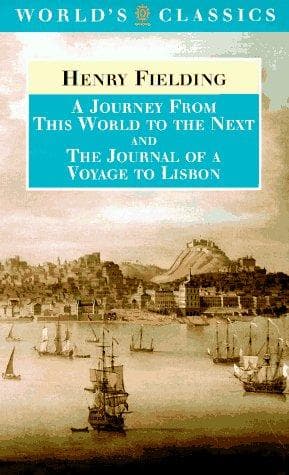
A Journey from This World to the Next — John Shaqi
A Journey from This World to the NextFielding, Henry
General
A Journey from This World to the Next
Fielding, Henry
English fiction; Paranormal fiction; Supernatural -- Fiction
He spoke the last word with so much fury, and seemed so confounded,
that, perceiving the effect it had on him, I immediately waived the
story, and, passing to other matters, we had much conversation touching
giants. He said, so far from killing any, he had never seen one alive;
that he believed those actions were by mistake recorded of him, instead
of Jack the giant-killer, whom he knew very well, and who had, he
fancied, extirpated the race. I assured him to the contrary, and told
him I had myself seen a huge tame giant, who very complacently stayed in
London a whole winter, at the special request of several gentlemen and
ladies; though the affairs of his family called him home to Sweden.
I now beheld a stern-looking spirit leaning on the shoulder of another
spirit, and presently discerned the former to be Oliver Cromwell, and
the latter Charles Martel. I own I was a little surprised at seeing
Cromwell here, for I had been taught by my grandmother that he was
carried away by the devil himself in a tempest; but he assured me, on
his honor, there was not the least truth in that story. However, he
confessed he had narrowly escaped the bottomless pit; and, if the former
part of his conduct had not been more to his honor than the latter, he
had been certainly soused into it. He was, nevertheless, sent back to
the upper world with this lot:--ARMY, CAVALIER, DISTRESS.
He was born, for the second time, the day of Charles II’s restoration,
into a family which had lost a very considerable fortune in the service
of that prince and his father, for which they received the reward very
often conferred by princes on real merit, viz.--000. At 16 his father
bought a small commission for him in the army, in which he served
without any promotion all the reigns of Charles II and of his brother.
At the Revolution he quitted his regiment, and followed the fortunes
of his former master, and was in his service dangerously wounded at the
famous battle of the Boyne, where he fought in the capacity of a private
soldier. He recovered of this wound, and retired after the unfortunate
king to Paris, where he was reduced to support a wife and seven children
(for his lot had horns in it) by cleaning shoes and snuffing candles at
the opera. In which situation, after he had spent a few miserable years,
he died half-starved and broken-hearted. He then revisited Minos, who,
compassionating his sufferings by means of that family, to whom he had
been in his former capacity so bitter an enemy, suffered him to enter
here.
My curiosity would not refrain asking him one question, i. e., whether
in reality he had any desire to obtain the crown? He smiled, and said,
“No more than an ecclesiastic hath to the miter, when he cries Nolo
episcopari.” Indeed, he seemed to express some contempt at the question,
and presently turned away.
Public-domain text, read in full here on John Shaqi.
Reviews
Reviews
No reviews yet
Be the first to share your thoughts on this work.
Join the Discussion
Join the discussion
Sign in to leave a comment or review.
Sign InorCreate an account