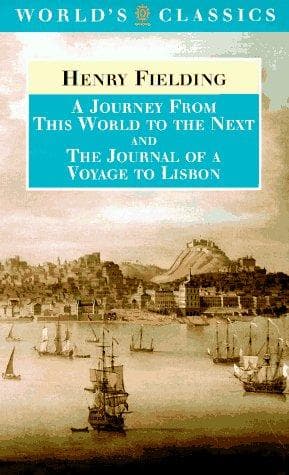
A Journey from This World to the NextFielding, Henry
General
A Journey from This World to the Next
Fielding, Henry
English fiction; Paranormal fiction; Supernatural -- Fiction
I arrived just as the coach was setting out, and found I had no reason
for inquiry; for every person seemed to know my business the moment I
appeared at the door: the coachman told me his horses were to, but
that he had no place left; however, though there were already six, the
passengers offered to make room for me. I thanked them, and ascended
without much ceremony. We immediately began our journey, being seven in
number; for, as the women wore no hoops, three of them were but equal to
two men. Perhaps, reader, thou mayest be pleased with an account of
this whole equipage, as peradventure thou wilt not, while alive, see any
such. The coach was made by an eminent toyman, who is well known to
deal in immaterial substance, that being the matter of which it was
compounded. The work was so extremely fine, that it was entirely
invisible to the human eye. The horses which drew this extraordinary
vehicle were all spiritual, as well as the passengers. They had,
indeed, all died in the service of a certain postmaster; and as for the
coachman, who was a very thin piece of immaterial substance, he had the
honor while alive of driving the Great Peter, or Peter the Great, in
whose service his soul, as well as body, was almost starved to death.
Such was the vehicle in which I set out, and now, those who are not
willing to travel on with me may, if they please, stop here; those who
are, must proceed to the subsequent chapters, in which this journey is
continued.
CHAPTER II
In which the author first refutes some idle opinions
concerning spirits, and then the passengers relate their
several deaths.
It is the common opinion that spirits, like owls, can see in the dark;
nay, and can then most easily be perceived by others. For which reason,
many persons of good understanding, to prevent being terrified with
such objects, usually keep a candle burning by them, that the light may
prevent their seeing. Mr. Locke, in direct opposition to this, hath not
doubted to assert that you may see a spirit in open daylight full as
well as in the darkest night.
Public-domain text, read in full here on John Shaqi.
Reviews
Reviews
No reviews yet
Be the first to share your thoughts on this work.
Join the Discussion
Join the discussion
Sign in to leave a comment or review.
Sign InorCreate an account