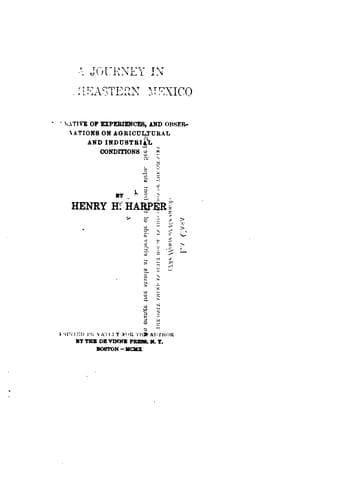
A Journey in Southeastern MexicoHarper, Henry Howard
History
A Journey in Southeastern Mexico
Harper, Henry Howard
Tuxpan de Rodríguez Cano (Mexico); Veracruz-Llave (Mexico : State) -- Description and travel
Although the peon class are indigent, lazy and utterly devoid of
ambition they are so by virtue of climatic and other conditions that
surround them, and of which they can be but the natural outgrowth. The
debilitating effects of the climate, and the numberless bodily pests
draw so heavily upon human vitality that it is surprising that any one
after a year's residence there can muster sufficient energy to work at
all. The natives, after a day's labor will throw themselves upon the
hard ground and fall asleep, calmly submitting to the attack of fleas
and wood-ticks as a martyrdom from which it is useless to attempt to
escape. It is a labored and painful existence they lead, and it is not
to be wondered at that smallpox, pestilence and death have no terror
for them; indeed, they hail these as welcome messengers of relief.
When by the pangs of hunger they are driven to the exertion of work
they will do a fair day's labor, if kept constantly under the eye of a
watchman, or _capitan_, as he is called. One of these is required for
about every ten or twelve workmen; otherwise they would do nothing at
all. If twenty workmen were sent to the field to cut brush, without
designating someone as captain, they would not in the course of the
whole day clear a patch large enough to sit down on. The best workmen
are the Indians that come down from the upper-country settlements.
Upon leaving home they take along about twelve days' rations, usually
consisting of black beans and corn ground up together into a thick
dough and made into little balls a trifle larger than a hen's egg,
and baked in hot ashes. They eat three of these a day,--one for each
meal,--and when the supply is exhausted they collect their earnings
and return to their homes, no matter how urgent the demand for their
continued service may be. In two or three weeks they will return again
with another supply of provisions and stay until it is consumed, but no
longer. If Thoreau could have seen how modestly these people live he
would have learned a lesson in economic living such as he never dreamed
of. The frugality of his meagre fare at his Walden pond hermitage
would have appeared like wanton luxury by comparison. If the virtue
of honesty can be ascribed to any of these laborers the Indians are
entitled to the larger share of it. They keep pretty much to themselves
and seldom inter-marry or mingle socially with the dusky-skinned Aztecs.
Public-domain text, read in full here on John Shaqi.
Reviews
Reviews
No reviews yet
Be the first to share your thoughts on this work.
Join the Discussion
Join the discussion
Sign in to leave a comment or review.
Sign InorCreate an account