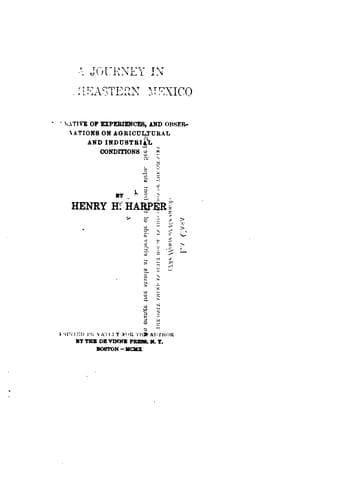
A Journey in Southeastern MexicoHarper, Henry Howard
History
A Journey in Southeastern Mexico
Harper, Henry Howard
Tuxpan de Rodríguez Cano (Mexico); Veracruz-Llave (Mexico : State) -- Description and travel
It may be observed that since arriving at Tuxpam I have appeared to
neglect my friend Mr. B., but, although so far as this narrative is
concerned he has not as yet been much in evidence, he was by far the
busiest man in the party. Being the only unmarried man in our company
he had not been long in Mexico when he began to busy himself with an
industry in which single men hold an unchallenged monopoly, and one
that is far more absorbing than vanilla, rubber, coffee, sugar and
tobacco all combined. The immediate cause of his diversion was due to
a visit that we all made to the large hacienda of a wealthy Spanish
gentleman of education and refinement, who had a very beautiful and
accomplished daughter but recently returned home with her mother from
an extended tour through Europe, following her graduation from a
fashionable and well-known ladies' seminary in America. I have made the
statement in the foregoing pages that no American fortune-hunter had
been known to return home from here richer than when he came, but later
on we shall see that this no longer remains a truth. For the present,
however, as long as we are now discussing problems of vulgar commerce,
we shall leave Mr. B. undisturbed in his more engaging pursuit, and
return to his case later.
Next to silver, corn is the staple and standard of value in Mexico,
though its price fluctuates widely. Everybody, and nearly every
animal, both untamed and domestic, and most of the insects, feed upon
this article. It is the one product of the soil that can be readily
utilized and converted into cash in any community and at any season.
The price is usually high, often reaching upwards of the equivalent of
$1 a bushel. It is measured not by the bushel, but by the _fanega_,
which weighs 225 pounds. It may appear a strange anomaly that the
principal native product should be so high in a soil of such wonderful
productivity. An acre of ground will produce from fifty to seventy-five
bushels, _twice a year_. It is planted in June as soon as the rains
break the long, monotonous dry season which extends through March,
April and May, and is harvested early in October; then the same ground
is planted again in December for harvesting early in April. The ground
requires no plowing and, if recently cleared, no weeding; so all that
is necessary to do is to plant the corn and wait for it to mature. It
sounds easy and looks easy, but, as with everything else, there are a
few obstacles. Corn is planted in rows, about the same distance apart
as in America, and is almost universally of the white variety, as this
is the best for _tortillas_. The planting is accomplished by puncturing
the ground with a hardwood pole, sharpened at one end. The hole is
made from four to six inches deep, when the top of the pole is moved
from one side to another so that the point loosens up the subsoil and
makes an opening at the bottom of the hole the same width as that at
the top.
Public-domain text, read in full here on John Shaqi.
Reviews
Reviews
No reviews yet
Be the first to share your thoughts on this work.
Join the Discussion
Join the discussion
Sign in to leave a comment or review.
Sign InorCreate an account