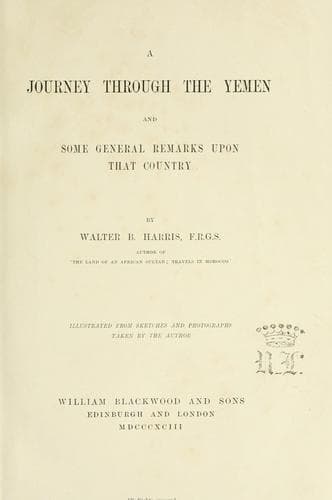
A journey through the Yemen and some general remarks upon that countryHarris, Walter
History
A journey through the Yemen and some general remarks upon that country
Harris, Walter
Yemen (Republic) -- Description and travel
Several times along the road we passed the deep rock-cut tanks that even
to-day form the water-supply of the passing caravans. One that we stopped
to drink at as evening was approaching bore rough designs of men on
horseback, and inscriptions in the Himyaric language cut in the plaster
that lined the rock walls. Like so many of these tanks, a flight of steps
led to the water’s edge, at the summit of which was a smaller pool, to be
filled by hand for the beasts of burden to drink from, and, like the main
reservoir, circular in form. The mountains we had seen all the afternoon
far ahead of us were now growing nearer, and as evening drew on we found
ourselves in a large open valley, semicircular in form, and closed at the
far end by steep broken crags. The soil here was well cultivated, though,
as we were still nearly nine thousand feet above the sea-level, the
young crops had not yet begun to show, and the place looked dreary and
burnt up. That the soil must repay cultivation is evident from the great
number of wells distributed over the country. At many of these, men,
women, and camels were engaged in drawing water. A couple of tree-trunks
form uprights to a beam laid across their tops, over which the rope
that supports the skins in which the water is raised passes. At the
other end of the rope, men, women, or some beast of burden is harnessed.
Owing to the great depth of these wells, and the size of the skins used
as buckets, the weight to be raised is very great, and the labour of
raising it proportionately so. But the natives have discovered a means by
which the work is lessened, while at the same time their irrigation is
rendered more practicable—namely, by building the wells upon the summits
of mounds. A long sloping path leads from the high mouth of the well to
the level of the surrounding fields, so that the drawer, harnessed to
the end of the rope, is assisted by the centre of gravity, instead of
being dependent upon his, her, or its personal strength. This raising of
the wells above the fields also renders easy the carrying of the water
in little dikes to whatever spot it is needed. The skin, on reaching the
well’s mouth, empties itself into a trough from which the water pours
into the irrigating channels. The fact that these channels consist of
only small ditches adds much to the toil and labour, as the thirsty soil
sucks up a large quantity of the fluid before it reaches its destination.
However, labour is cheap, and a man, so long as he possesses a donkey, a
camel, or a wife to work his well, can sit and smoke and look on himself.
Public-domain text, read in full here on John Shaqi.
Reviews
Reviews
No reviews yet
Be the first to share your thoughts on this work.
Elsewhere in the archive
Join the Discussion
Join the discussion
Sign in to leave a comment or review.
Sign InorCreate an account