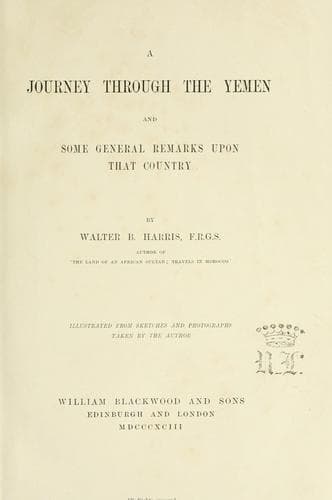
A journey through the Yemen and some general remarks upon that countryHarris, Walter
History
A journey through the Yemen and some general remarks upon that country
Harris, Walter
Yemen (Republic) -- Description and travel
At length we drew up at the village khan of Maaber, our resting-place,
and climbing a rough outside staircase, found ourselves in a clean
whitewashed room, cool and airy, where our carpets were quickly spread
and coffee on the boil. The people were very inquisitive, and at last I
was obliged to give peremptory orders that no one was to be allowed to
enter my room. But this did not seem to be of much avail, and eventually
I posted a guard outside the door, armed with a long stick. The village
is a poor enough place, built of mud-bricks, with a little stone masonry
showing here and there. The people seemed poor and dirty, and there
was little or nothing of interest to be seen. Very different are these
villages of the plateau to the well-built and fortified towers of the
country we had passed through to the south of Yerim, nor were the people
of this part half so clean or genial or handsome as the wild mountaineers.
Early the next morning we were on our way again, the road continuing over
the dusty plain. A mile or two from Maaber we witnessed some skirmishing
between the Turkish troops and the hillmen of Jibel Anis, one of the
last tribes to hold out, and one that probably will never surrender to
the Turkish Government. The country inhabited by this tribe consists of
wild inaccessible country, into which the Osmanli troops are powerless
to penetrate. The battle we witnessed was not apparently a very bloody
affair, for it consisted principally in a small field-battery of the
Turks firing into a few hill villages, from which a desultory and
ill-aimed fire was kept up by the Arabs. This was the first active sign
we had as yet seen of the rebellion; for although Turkish garrisons were
to be found in Dhamar and Yerim, their reconquest of these cities from
the Arabs had been accomplished almost without bloodshed. For a time we
stayed and watched the little battle, listening to the sharp cracking
of the rifles and the louder tones of the field-guns, until, as it was
apparent that the Turks had no idea of trying to climb to the villages
or the Arabs of descending to the level, we continued our journey. The
plain ends in an abrupt line of high rocky mountains, over which we
could see our path twisting and turning in serpentine coils. Entering
a narrow gorge, we passed close under the grandly situated village of
Kariat en-Negil, its every rock crowned by stone towers—a striking and
wild-looking place. Here it is that the old pilgrim-road from Aden and
the Hadramaut probably joins the track I had travelled on. We had left
the old road at Lahej, whence it continues _viâ_ Ibb, our route lying
more to the east. I have mentioned elsewhere this great pilgrim-track,
founded by Huseyn ibn Salaamah in the fifth century A.H., and there is no
further need of description here. Suffice it to say that at every night’s
_nzala_, or resting-place, was built a mosque, while tanks refreshed the
weary with water by the way.
[Illustration: KHADAR.]
Public-domain text, read in full here on John Shaqi.
Reviews
Reviews
No reviews yet
Be the first to share your thoughts on this work.
Elsewhere in the archive
Join the Discussion
Join the discussion
Sign in to leave a comment or review.
Sign InorCreate an account