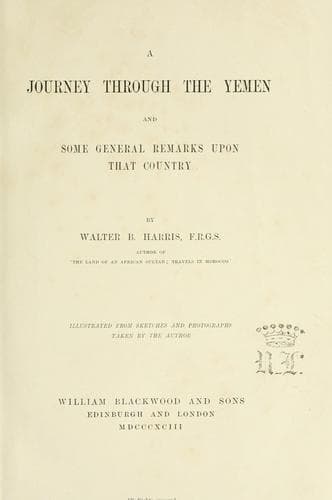
A journey through the Yemen and some general remarks upon that countryHarris, Walter
History
A journey through the Yemen and some general remarks upon that country
Harris, Walter
Yemen (Republic) -- Description and travel
Although one cannot see the interior of the Arab houses of Sanaa, a fair
estimate of their size can be gained from the outside; and even to us
English, who are used to great houses, many of those of Sanaa appear
immense. It is impossible to describe the style of architecture in which
they are built, for it is a style that exists nowhere else. It is purely
and essentially Yemenite, though in some cases gateways and windows are
found of Byzantine and Gothic form. There is one house at Dhamar, built
of red brick and faced with white stone, with a stone porch, that, were
it set down in an English country district, would pass for Elizabethan.
The house, too, forms an E, and although I could find out nothing about
its history, it seems impossible that the strange building could be an
accident; and I am inclined to believe that it must have been erected by
one of the many renegades who, in the middle ages, sought their fortunes
in the wealthy cities of Arabia.
At Sanaa I saw no houses of this kind, the style of architecture, with
the exception of the decoration of doors and windows, being more or less
uniform. Many of the larger houses are built of stone and brick and
cement, the lower two storeys perhaps being of well-squared stone of
various colours, arranged so as to form designs, the upper portion being
of brick covered with a hard cement that takes a fine polished surface,
not unlike the material used in Cairo, and corresponding to the _tabbia_
of Fez. Many of the upper storeys are built overhanging the streets, but
this is not carried out to nearly such a large extent as in many of the
oriental cities; while the _musher-ibeyeh_ work of Cairo is rare here,
its place being taken by long narrow windows filled in with stained
glass in designs. From the outside the pattern is often inappreciable,
as the chips of glass are simply stuck into the plaster framework. From
within, however, only such of the glass is exposed as fits in between
the solid pattern, and the designs are often exceedingly fine. The same
can be seen in the tomb and mosque of Kaït Bey, one of the tombs of the
Caliphs at Cairo, and again some specimens of the work exist in the
museum of Arab antiquities in the same city. What carved wood there is
used for window-screens does not in the least resemble that of Egypt, but
is arranged in geometric designs, much more in the style of Chinese and
Japanese workmanship, with which some of the designs are identical.
Public-domain text, read in full here on John Shaqi.
Reviews
Reviews
No reviews yet
Be the first to share your thoughts on this work.
Elsewhere in the archive
Join the Discussion
Join the discussion
Sign in to leave a comment or review.
Sign InorCreate an account