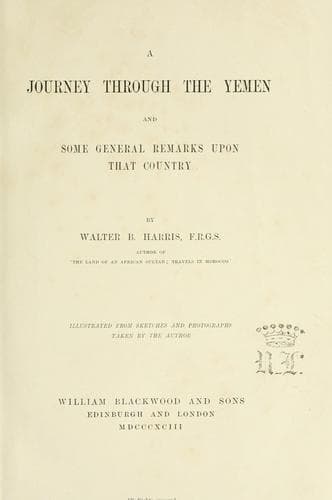
A journey through the Yemen and some general remarks upon that countryHarris, Walter
History
A journey through the Yemen and some general remarks upon that country
Harris, Walter
Yemen (Republic) -- Description and travel
A word must be said here on the extraordinary quantity of Chinese and
Japanese pottery to be found in the Yemen. There is scarcely a _café_ by
the roadside where one will not find that the cups have come from the far
East, and yet I found that but very little enters the country to-day.
I believe the origin of the presence of this extraordinary amount of
oriental pottery is to be traced to the last few centuries, when Aden
was the great mart of exchange between the East and Europe. With great
wealth in the cities of the Yemen, a very appreciable quantity of the
goods brought to Aden would be taken into the interior, and the care with
which pottery and antiquities are treasured by the natives of the country
would explain their existing until to-day. There is little doubt that
should the Yemen ever be opened up, and Europeans be able to travel with
safety and comfort, that it will become a field for the curio-hunter such
as has not been known since the days when the Egyptian antiquities began
to be unearthed. Coins, gems, inscriptions, sculptures, old Persian and
Arab antiquities, embroideries, arms, brass and copper work, manuscripts,
carpets, oriental pottery and glass—the Yemen is full of them, and as yet
her treasures are almost untouched.
Although many of the streets of the town consist of narrow byways,
turning and twisting in every direction between the high walls of the
houses, there are parts that are by no means badly laid out, and one
or two of the main streets are quite wide thoroughfares, in which the
few carriages which Sanaa boasts are able to pass each other. The
most important of these streets leads from the square into which the
Government buildings look to the bazaars. It is only a few hundred yards
in length, it is true, but still it is sufficiently wide, and the shops
on either side sufficiently good, to compare favourably with many in
European towns. The “square” itself is a large oblong open space, faced
on the east by the old castle and the large much-bedomed Turkish mosque,
and on the west by what were once the palaces of the Arab rulers, and
to-day form barracks and Government offices. At one end of the square
an enterprising Turk has built a large _café_, where the officers and
the few Greek shopkeepers love to congregate, and from the large doors
and windows of which float clouds of pale-blue tobacco-smoke, issuing in
curling clouds from the _shishas_ of the smokers. It is from this point
that the main street leads off to the bazaars, and in the few hundred
yards of thoroughfare are to be seen the best shops, kept either by Turks
or by Greeks, in which every imaginable article can be procured, from
tins of sardines and inferior Turkish cigarettes to photograph-frames
and musty chocolate creams. One or two have large glass windows in which
the goods are exposed to view, but they have a dingy dusty appearance,
and seem to tell that trade is not bright. There, too, is a small
Public-domain text, read in full here on John Shaqi.
Reviews
Reviews
No reviews yet
Be the first to share your thoughts on this work.
Elsewhere in the archive
Join the Discussion
Join the discussion
Sign in to leave a comment or review.
Sign InorCreate an account