A Joy For Ever (and Its Price in the Market) — John Shaqi
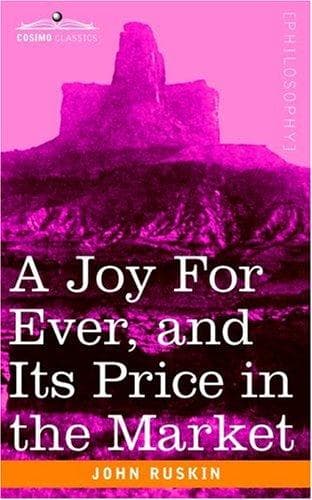
A Joy For Ever (and Its Price in the Market)Ruskin, John
Philosophy
A Joy For Ever (and Its Price in the Market)
Ruskin, John
Art
1. Among the various characteristics of the age in which we live, as
compared with other ages of this not yet _very_ experienced world, one
of the most notable appears to me to be the just and wholesome contempt
in which we hold poverty. I repeat, the _just_ and _wholesome_ contempt;
though I see that some of my hearers look surprised at the expression. I
assure them, I use it in sincerity; and I should not have ventured to
ask you to listen to me this evening, unless I had entertained a
profound respect for wealth--true wealth, that is to say; for, of
course, we ought to respect neither wealth nor anything else that is
false of its kind: and the distinction between real and false wealth is
one of the points on which I shall have a few words presently to say to
you. But true wealth I hold, as I said, in great honour; and sympathize,
for the most part, with that extraordinary feeling of the present age
which publicly pays this honour to riches.
2. I cannot, however, help noticing how extraordinary it is, and how
this epoch of ours differs from all bygone epochs in having no
philosophical nor religious worshippers of the ragged godship of
poverty. In the classical ages, not only were there people who
voluntarily lived in tubs, and who used gravely to maintain the
superiority of tub-life to town-life, but the Greeks and Latins seem to
have looked on these eccentric, and I do not scruple to say, absurd
people, with as much respect as we do upon large capitalists and landed
proprietors; so that really, in those days, no one could be described as
purse proud, but only as empty-purse proud. And no less distinct than
the honour which those curious Greek people pay to their conceited poor,
is the disrespectful manner in which they speak of the rich; so that
one cannot listen long either to them, or to the Roman writers who
imitated them, without finding oneself entangled in all sorts of
plausible absurdities; hard upon being convinced of the uselessness of
collecting that heavy yellow substance which we call gold, and led
generally to doubt all the most established maxims of political economy.
3. Nor are matters much better in the Middle Ages. For the Greeks and
Romans contented themselves with mocking at rich people, and
constructing merry dialogues between Charon and Diogenes or Menippus, in
which the ferryman and the cynic rejoiced together as they saw kings and
rich men coming down to the shore of Acheron, in lamenting and
lamentable crowds, casting their crowns into the dark waters, and
searching, sometimes in vain, for the last coin out of all their
treasures that could ever be of use to them.
Public-domain text, read in full here on John Shaqi.
Reviews
Reviews
No reviews yet
Be the first to share your thoughts on this work.
Join the Discussion
Join the discussion
Sign in to leave a comment or review.
Sign InorCreate an account