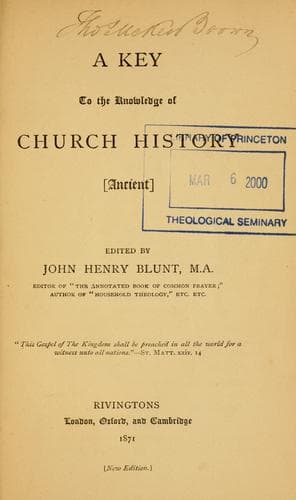
A Key to the Knowledge of Church History (Ancient) — John Shaqi
A Key to the Knowledge of Church History (Ancient)Blunt, John Henry
History
A Key to the Knowledge of Church History (Ancient)
Blunt, John Henry
Church history -- Middle Ages, 600-1500; Church history -- Primitive and early church, ca. 30-600
The CHURCH OF FRANCE was probably founded by St. Paul, but we have no
certain account of its early history. [Sidenote: Asiatic origin of
Early French Bishops,] "Trophimus the Ephesian" is believed to have
been the first Bishop of Arles, and Pothinus, another Greek Asiatic,
occupied the see of Lyons at the time of the persecution under Marcus
Aurelius, A.D. 161-A.D. 180, during which he suffered martyrdom. His
{78} successor was St. Irenaeus, a native, probably, of Smyrna, who was
martyred under Severus, A.D. 202. This long-continued connexion with
the Churches of Asia Minor left its traces on the liturgy and customs
of the Church of France, and through it of Britain and Ireland, these
latter Churches adhering to the Eastern mode of computing Easter even
after the Western reckoning had been adopted in France. [Sidenote: and
of French Liturgy.] The liturgy used in France, as well as in Britain
and Spain, is known to have been founded on that used in Ephesus and in
the other Asiatic cities, which was almost certainly that used by St.
John himself.
[Sidenote: Intercourse between English and French Churches.]
A Council was summoned by Constantine, A.D. 314, at the French city of
Arles, and one French Bishop at least was present at the great Nicaean
Council, A.D. 323. About a century later (A.D. 429), St. Germanus,
Bishop of Auxerre, and St. Lupus, Bishop of Troyes, were sent over to
Britain to assist in combating the errors of Pelagius, the neighbour
Churches of England and France maintaining apparently very friendly
relations. Many of the barbarian tribes who overran France in the
beginning of the fifth century, though professing Christianity, were
deeply infected with the Arian heresy. The Franks, however, who were
heathens at their first entrance into the country, embraced the
orthodox faith, and eventually became masters of the kingdom under
Clovis, A.D. 486.
[Sidenote: St. Paul and St. James in Spain.]
The CHURCH OF SPAIN AND PORTUGAL traces its foundation to St. Paul, who
speaks of his intended visit to Spain, Rom. xv. 24; and there is also a
tradition that St. James the Great preached the Gospel here. This
Church, too, is spoken of by St. Irenaeus, and again by Tertullian.
{79} Its first known martyr was St. Fructuosus, A.D. 259, and its first
Council that of Elvira, about A.D. 300. The names of nineteen Spanish
Bishops are mentioned as present at it. The Council of Nice, A.D. 325,
was under the presidency of Hosius, the Bishop of the Spanish diocese
of Cordova. [Sidenote: Arianism of Visigoths.] About A.D. 470, the
Visigoths, who were Arians, passed over from France into Spain, and
were only gradually converted to the Catholic Faith.
Public-domain text, read in full here on John Shaqi.
Reviews
Reviews
No reviews yet
Be the first to share your thoughts on this work.
Join the Discussion
Join the discussion
Sign in to leave a comment or review.
Sign InorCreate an account