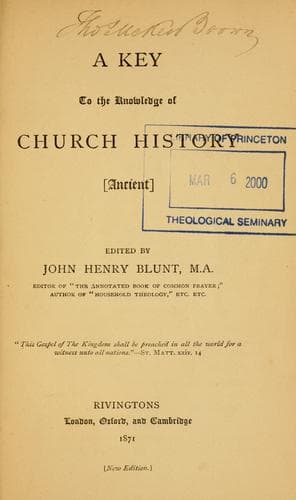
A Key to the Knowledge of Church History (Ancient)Blunt, John Henry
History
A Key to the Knowledge of Church History (Ancient)
Blunt, John Henry
Church history -- Middle Ages, 600-1500; Church history -- Primitive and early church, ca. 30-600
The Apostles received from the Great High Priest before His Ascension,
a commission to execute the various functions of the priestly office,
to baptize[7], to teach[8], to consecrate and offer the Holy
Eucharist[9], and to absolve[10]; besides a general and comprehensive
promise that all their official acts should be confirmed by Him, in the
words, "Lo, I am with you alway, even unto the end of the world[11]."
[Sidenote: but not exerted till after Pentecost.] We do not, however,
find that this commission was acted on by the Apostles before the day
of Pentecost; the Saviour's will was, that it should, so to {7} speak,
lie dormant until the seal of the Holy Spirit was impressed upon it.
During the days of expectation which followed our Lord's Ascension, we
read that the holy company who were gathered together in the "upper
room," "continued with one accord in prayer and supplication[12];" but
we have no mention of any celebration of the Holy Eucharist, whilst
immediately after the Descent of the Holy Ghost we are told of their
daily continuance in "the Breaking of the Bread[13]."
Section 3. _The Day of Pentecost._
[Sidenote: A.D. 33. Participation of the Blessed Trinity in the works
of Creation, the Incarnation, and the Foundation of the Church.]
As the Three Holy Persons of the Ever-blessed Trinity had shared in the
work of the First Creation of the world, the Father speaking by the
Eternal Word, and the Holy Spirit brooding over what before was
lifeless: and as in the work of the Incarnation the Father had sent the
Son to take upon Him our human nature through the operation of the Holy
Ghost: so, in the Foundation of the Church, the Power of the Holy
Spirit co-operated no less than the Will of the Father and the
Life-giving Grace of the Son.
{8}
[Sidenote: The waiting at Jerusalem.]
The Apostles had received from their ascending Lord a command to await
in the City of Jerusalem this "Power from on High," which was to be
sent upon them[14]. We can easily see the fitness of this injunction,
when we remember that they were about to become the founders of the New
Jerusalem, the true "City of God" in which the many "glorious things
spoken[15]" by the Old Testament Prophets were to have their
performance to a certain extent even in this life, but fully and
perfectly in the Life to come.
[Sidenote: St. Matthias chosen.]
Public-domain text, read in full here on John Shaqi.
Reviews
Reviews
No reviews yet
Be the first to share your thoughts on this work.
Join the Discussion
Join the discussion
Sign in to leave a comment or review.
Sign InorCreate an account