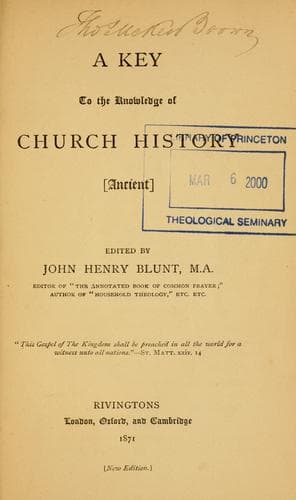
A Key to the Knowledge of Church History (Ancient)Blunt, John Henry
History
A Key to the Knowledge of Church History (Ancient)
Blunt, John Henry
Church history -- Middle Ages, 600-1500; Church history -- Primitive and early church, ca. 30-600
From the death of Innocent IV. the excessive power of the Popes may be
said to decrease. Gregory X. (A.D. 1271-A.D. 1276) and the Emperor
Rudolf of Hapsburg were good, earnest-minded men, who put an end to the
long-standing feud between Rome and the empire, and after a succession
of short pontificates, Boniface VIII. (A.D. 1294-A.D. 1303) usurped the
papal throne in the place of the "hermit Pope," Celestine V.
[Sidenote: Interference of the King of France in papal affairs.]
Boniface was a thoroughly bad and unscrupulous man, and at last died in
a fit of disappointed rage at being taken prisoner by the troops of his
equally unscrupulous enemy, Philip IV. of France, who had refused to
acknowledge the {108} authority of the papal legate. Philip caused the
death of Benedict XI. (A.D. 1303-A.D. 1304), whose honest goodness he
feared, and then used his influence to procure the election of Clement
V. (A.D. 1303-A.D. 1314), on condition of his pledging himself to aid
in the French king's schemes to plunder and oppress the Church.
Clement, having thus sold himself, was not allowed to leave France, and
the papal court was fixed at Avignon. The Pope was now completely at
the mercy of Philip, who robbed the Church at his will, and plundered
and murdered the Knights Templars with the connivance of Clement.
[Sidenote: The Popes at Avignon.] The sojourn of the Popes at Avignon
(A.D. 1305-A.D. 1376) was a great blow to the temporal power of the
papacy, and was often called by the Italians the Seventy Years'
Captivity. Meanwhile the Popes were again plunged into contests with
the German emperors: Louis of Bavaria was excommunicated, and his
empire laid under an interdict, on account of his refusal to accept his
dominions from John XXII. (A.D. 1316-A.D. 1334). The papal authority
in Italy had become almost nominal except in Rome itself, and even
there it was much weakened by the rebellion under Rienzi, A.D. 1352.
Pope Innocent VI. (A.D. 1333-A.D. 1362), soon after his election, sent
a legate to Rome, with orders to reduce not only the city itself to
obedience, but all that was then included in the States of the Church;
and this having been successfully accomplished, the Popes began to
think of returning to Rome. [Sidenote: The return to Rome.] The court
at Avignon had become fearfully corrupt, and some of those who composed
it, and loved its evils, were ready to oppose any change; but Urban V.
(A.D. 1362-A.D. 1370), a really upright man, spent some of his
episcopate at Rome, and his {109} successor, Gregory XI. (A.D.
1370-A.D. 1378) removed thither with his court two years before his
death. The Cardinals however still clung to Avignon, and though, in
compliance with the earnest wishes of the Roman people, they elected an
Italian to be Pope under the name of Urban VI. (A.D. 1378-A.D. 1389),
yet they were so offended at his zealous but indiscreet endeavours to
reform the evils around him, that they declared him deposed, and set up
an anti-Pope at Avignon.
Public-domain text, read in full here on John Shaqi.
Reviews
Reviews
No reviews yet
Be the first to share your thoughts on this work.
Elsewhere in the archive
Join the Discussion
Join the discussion
Sign in to leave a comment or review.
Sign InorCreate an account