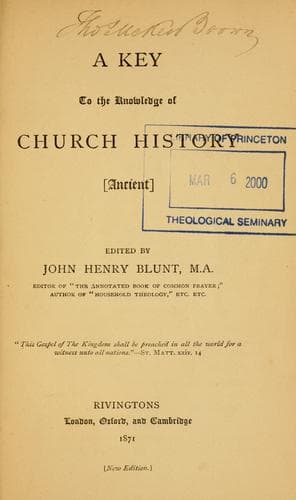
A Key to the Knowledge of Church History (Ancient)Blunt, John Henry
History
A Key to the Knowledge of Church History (Ancient)
Blunt, John Henry
Church history -- Middle Ages, 600-1500; Church history -- Primitive and early church, ca. 30-600
[Sidenote: The consequent schism.] The schism
thus begun lasted nearly forty years (A.D. 1378-A.D. 1417), England,
Germany, North Italy, Poland, and the Scandinavian kingdoms siding with
the true Popes, while France, Scotland, Spain, and South Italy held
with the anti-Popes. [Sidenote: Its results.] The troubles and
corruptions of the Church now multiplied, Popes and anti-Popes alike
made the acquisition of power and revenue their great object, and
wickedness was left unrebuked both in Clergy and laity. A great
impulse was given to the sale of indulgences or pardons, an evil
practice which brought in large sums of money to the papal exchequer,
and at the same time led to such abuses as probably to become a
principal proximate cause of the Reformation.
[Sidenote: Council of Pisa.]
At length there was an universal longing for the cessation of the great
schism in the Western Church, and a Council was held at Pisa, A.D.
1409, where it was agreed by the Cardinals belonging to the two parties
to depose both Pope and anti-Pope, and to elect another who took the
name of Alexander V., with an understanding that he was at once to
reform and pacify the Church. But neither Pope nor anti-Pope would
resign, so that there were three claimants instead of two, and very
soon after his {110} election Alexander V. died. John XXIII. (A.D.
1410-A.D. 1415) was elected in his place, but he proved to be
thoroughly devoid of principle, and the Council of Pisa having proved
unsuccessful in promoting unity or reformation, another was convoked at
Constance, A.D. 1414, under the presidency of the Emperor Sigismund I.
[Sidenote: Council of Constance.] This Council was attended by the
representatives of all the monarchs of the West, as well as by a very
large number of Bishops and Clergy, and it was decreed that the three
claimants to the papal throne should be deposed. John XXIII. was
thrown into prison, and, after considerable delay, Martin V. (A.D.
1417-A.D. 1431) was chosen to succeed him. The Council shortly after
broke up, without having done any thing towards the much desired
reformation of the Church, although the English, French, and German
deputies had been very earnest in their endeavours to advance some
scheme of reform. [Sidenote: Council of Basle.] Another Council met at
Basle, A.D. 1431, whence it was transferred by Pope Eugenius IV. (A.D.
1431-A.D. 1447) first to Ferrara, and afterwards (A.D. 1439) to
Florence. This opportunity was also lost in a dispute between the
Council and the Pope, and there seemed to be nothing more to hope for
from Councils as a means of reformation.
[Sidenote: State of the papacy at the end of the fifteen century.]
Public-domain text, read in full here on John Shaqi.
Reviews
Reviews
No reviews yet
Be the first to share your thoughts on this work.
Elsewhere in the archive
Join the Discussion
Join the discussion
Sign in to leave a comment or review.
Sign InorCreate an account