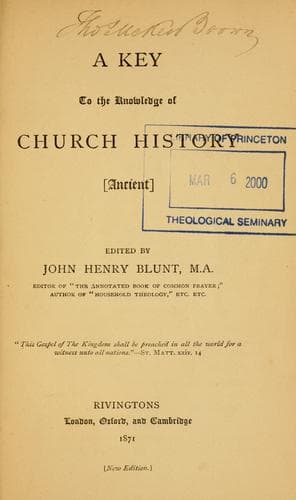
A Key to the Knowledge of Church History (Ancient)Blunt, John Henry
History
A Key to the Knowledge of Church History (Ancient)
Blunt, John Henry
Church history -- Middle Ages, 600-1500; Church history -- Primitive and early church, ca. 30-600
The First Crusade was the only one which had any real success, and even
this was a transient one, for less than ninety years afterwards (A.D.
1187) Jerusalem was again taken by the Saracens, and has never since
been a Christian power. But though the deliverance of the Holy Land
from the yoke of the infidels was not accomplished by the Crusades, and
though they caused much misery and bloodshed, and were stained by much
lawlessness and plunder, yet the advance of the barbarous and
anti-Christian influences of Mahometanism was checked, the Churches of
Europe were saved from the soul-destroying apostasy which had over-run
so large a portion of Asia, and the Crescent waned before the Cross.
{114}
[Sidenote: Reasons for their ill-success.]
Much of the ill success with which the Crusaders met during several of
these expeditions, may be traced to jealousies and heart-burnings
between the different princes and nobles who took part in them, whilst
disagreements on a larger scale were amongst the evil fruits of the
unhappy division between Eastern and Western Christendom. Latin
Christians appear in too many instances to have made use of the
opportunities afforded them to injure and oppress their weaker brethren
of the Greek Church, even whilst marching against the common foe of
both, and the Fourth Crusade (A.D. 1203) was actually diverted from its
legitimate purpose in order to conquer Constantinople, and establish a
Latin Emperor, as well as a Latin Patriarch within its walls.
[Sidenote: Good directly brought about by them.]
Still, whatever may have been the want of single-mindedness on the part
of many of the professed soldiers of the Cross, whatever the amount of
failure with regard to the immediate objects of the Crusades, it is
clear that much good was brought about through them by God's
Providence, not only in the check given to the encroachments of the
unbelievers, but also more indirectly in the quenching of rising
heresies, in the greater purity of life which in many cases accompanied
the taking of the Cross, the weakening of the feudal system, the
impulse given to learning and civilization. Earnestness and
self-devotion such as were shown by Godfrey de Bouillon, St. Louis of
France, and no doubt by many more amongst the Crusaders, were rewarded
and blessed, though not in what might have seemed at first sight the
only way of success.
{115}
Section 5. _State of Religions Relief and Practice during the Middle
Ages._
[Sidenote: Popular idea of the Middle Ages,]
There is a wide-spread notion that the Middle Ages were also "Dark
Ages," full of ignorance and superstition, with hardly a ray of
knowledge or true religion to enlighten the gloom, and also that the
Church was the great encourager of this state of things; indeed, that
it was mainly due to the influence of the monks and of the Clergy
generally.
[Sidenote: not founded in history.]
Public-domain text, read in full here on John Shaqi.
Reviews
Reviews
No reviews yet
Be the first to share your thoughts on this work.
Elsewhere in the archive
Join the Discussion
Join the discussion
Sign in to leave a comment or review.
Sign InorCreate an account