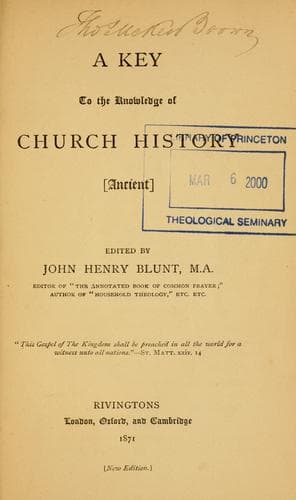
A Key to the Knowledge of Church History (Ancient)Blunt, John Henry
History
A Key to the Knowledge of Church History (Ancient)
Blunt, John Henry
Church history -- Middle Ages, 600-1500; Church history -- Primitive and early church, ca. 30-600
It is not easy to estimate the vast amount of good which the labours of
the Benedictine monks conferred on the Church of the Middle Ages, good
which has left many traces to the present day. Not only did they
provide in a vast number of instances for the spiritual wants of the
parishes in and near which they lived, as well as for the education of
the young, both rich and poor, but they were also the philosophers, the
authors, the artists, and the physicians, nay, even the farmers and the
mechanics of Mediaeval times. They built cathedrals and churches, made
roads and bridges, copied books when writing stood in the place of
printing, and were in general the props and pioneers of civilization.
Amongst the very large number of men who embraced the monastic life, it
is no marvel that some were not all they professed to be, or that
occasional causes for scandal arose, but the popular idea of the
universal corruption of the inhabitants of the monasteries is
unsupported by facts, and much of what helped to give rise to this
false notion is traceable to the doings of the mendicant or preaching
friars. These begging orders were offshoots from the regulars, and
were but too often very unworthy representatives of the parent stock[2].
Section 4. _The Crusades._
Amongst the events which stand out most distinctly in the history of
the Church in the Middle Ages, the long series of warlike expeditions
known as the {113} Crusades bear a prominent part, stretching out as
they do from the end of the eleventh to nearly the end of the
thirteenth centuries.
The empire of the Arabs had died out, but they had been succeeded in
their schemes of conquest as well as in their adherence to the false
faith of Mahomet, by the savage Turks, whose ferocity and hatred of
Christianity were especially displayed in the ill-treatment of those
Christians whose piety led them to visit the scenes of our Blessed
Lord's Life and Death. [Sidenote: Cause of the Crusades.] The
indignation excited in Europe by the stories of outrage and desecration
which were from time to time brought back by pilgrims to the Holy Land,
at length found an outlet and expression in the First Crusade, which
was preached, A.D. 1095, by Peter the Hermit, with the sanction both of
the Pope and the Patriarch of Constantinople. This expedition resulted
in the taking of the Holy City by the armies of the Cross (A.D. 1099),
and the establishment in it of a Christian sovereignty.
[Sidenote: Their transient results.]
Public-domain text, read in full here on John Shaqi.
Reviews
Reviews
No reviews yet
Be the first to share your thoughts on this work.
Elsewhere in the archive
Join the Discussion
Join the discussion
Sign in to leave a comment or review.
Sign InorCreate an account