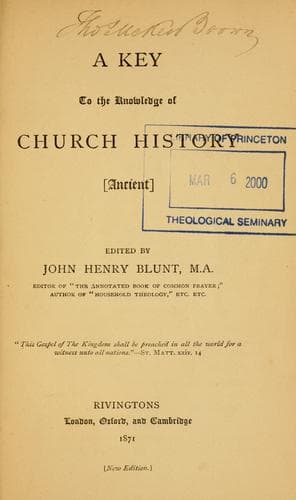
A Key to the Knowledge of Church History (Ancient)Blunt, John Henry
History
A Key to the Knowledge of Church History (Ancient)
Blunt, John Henry
Church history -- Middle Ages, 600-1500; Church history -- Primitive and early church, ca. 30-600
The Mediaeval Church was, in reality, a great supporter of learning.
Our two great Universities of Oxford and Cambridge were not less
flourishing during the Middle Ages than at present; and nearly all of
the colleges and halls at both Universities were founded in those days
{118} of supposed darkness. Nor was this care for literature confined
to the Church in England; Universities of equal note were to be found
abroad at Paris, Pavia, Bologna, Salamanca, and other places, whilst
the Schoolmen, or professors, who taught in these seats of learning,
and who numbered amongst themselves the most acute thinkers and
reasoners of the time, such as St. Anselm, Peter Lombard, Albertus
Magnus, and St. Thomas Aquinas, were all attached to some Religious
Order. Enough of the results of their labours have come down to our
days to show us that it is neither wise nor just to despise the mental
work which they accomplished, even though their conclusions may not
always be in accordance with our own.
It is not meant by what has been said above to infer that the Mediaeval
Church was altogether free from blemishes, or to deny that these
blemishes did, as time went on, increase to an extent which rendered
reformation not only expedient but necessary. [Sidenote: The effects
of Roman influence.] We have already seen that the supremacy claimed by
the Popes over the whole Church was productive of great, though, by
God's good Providence, not unmitigated, evil in a political point of
view; and much of the error in faith or practice on the part of
Christians of those days, seems traceable to the tendency on the part
of Rome to crystallize opinions into dogmas, and then to impose those
dogmas on the Church. Thus the "Romish doctrine concerning purgatory,"
and the mechanism of "pardons," or indulgences, grew out of the
floating belief held by such holy men as St. Augustine, that the souls
of the faithful would undergo some more perfect purification after
death than is attainable in this world; while the elaborate system of
invocations of, and devotions to, the Blessed {119} Virgin Mary and the
saints, were built up out of a not only harmless but justifiable faith
in the intercessions of the Saints for the Church on earth, and the
wish to obtain a share in their prayers. So again, the denial of the
cup to the laity, which was justly felt by many to be such a grievous
privation, was the natural consequence of the over-refinements of the
Roman Church respecting the doctrine of the Holy Eucharist[5].
[Sidenote: The right spirit in which to regard the Mediaeval Church.]
Public-domain text, read in full here on John Shaqi.
Reviews
Reviews
No reviews yet
Be the first to share your thoughts on this work.
Elsewhere in the archive
Join the Discussion
Join the discussion
Sign in to leave a comment or review.
Sign InorCreate an account