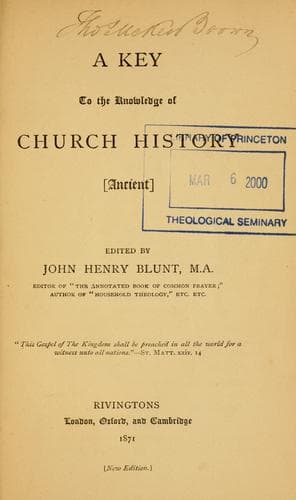
A Key to the Knowledge of Church History (Ancient)Blunt, John Henry
History
A Key to the Knowledge of Church History (Ancient)
Blunt, John Henry
Church history -- Middle Ages, 600-1500; Church history -- Primitive and early church, ca. 30-600
But whatever imperfections may have clung to the Visible Church in the
Middle Ages, whether owing to external hindrances, or to the human
frailties of her members, we have no right to doubt that she was still
the one great instrument in God's Hands for the salvation of souls.
Neither should we dwell so exclusively on what is often an exaggerated
estimate of the extent and duration of these blemishes, as to ignore
the zeal and self-devotion which grudged neither expense nor labour in
the service of God and the adornment of His House and Worship, the
charity which truly "cared for the poor," the faith and holiness which
shone forth in the public and private lives of such men as St.
Ferdinand of Spain, St. Louis of France, and Rudolf of Hapsburg,
Emperor of Germany, and were, doubtless, not wanting in the case of
countless numbers of their fellow-Christians, whose names, little known
and soon forgotten on earth, are for ever written in God's Book of
Remembrance.
[1] Especially the Cluniacs, founded by Berno, Abbot of Clugny, A.D.
910, and the Cistercians, founded by Robert of Citeaux, A.D. 1098, and
rendered illustrious by St. Bernard, afterwards Abbot of Clairvaux
(A.D. 1113-A.D. 1153).
[2] The order of Franciscan Friars was founded by St. Francis of
Assisi, A.D. 1207, and that of the Dominicans by St. Dominic of
Castile, A.D. 1215. They were originally intended to supplement the
real or supposed defects of the Clergy and the regular orders, and to
aid in the suppression of heresy.
[3] See "Key to the Prayer Book," pp. 1-8.
[4] See "Key to the Bible," pp. 18-23.
[5] The practice of communion in one kind made its way very slowly,
especially in England, where it was perhaps never universal. A decree
of the Council of Constance in A.D. 1415 gave its first authoritative
sanction.
{120}
CHAPTER XI
The Mediaeval History of Continental Churches
A.D. 900-A.D. 1500
[Sidenote: No Mediaeval Church history in Asia or Africa.]
Before proceeding to the consideration of the different European
Churches in Mediaeval times, it may be well to remark that from the
year 500 the Christian history of Asia and Africa is almost a blank.
Arianism, partly imported into Africa by the Vandals, who crossed
thither from Spain, and partly of native growth, as well as the
opposite error, Eutychianism, took from the African Church all
spiritual life and vigour, so that the apostasy of Mahomet met with no
formidable obstacles when in the seventh century it swept like a flood
over what had been Christian Africa. It is true that the Copts in
Egypt and the native Christians of Abyssinia appear to have preserved
the Apostolic Succession, but both these Churches are in a state of
great depression, and the Faith they profess is mingled with much
ignorance and superstition, as well as with positive error.
Public-domain text, read in full here on John Shaqi.
Reviews
Reviews
No reviews yet
Be the first to share your thoughts on this work.
Elsewhere in the archive
Join the Discussion
Join the discussion
Sign in to leave a comment or review.
Sign InorCreate an account