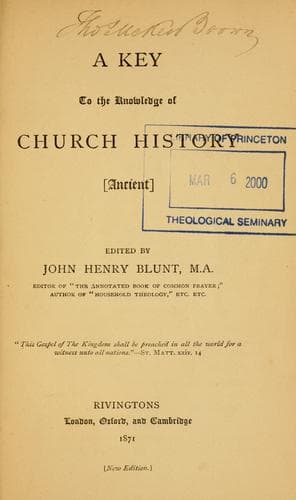
A Key to the Knowledge of Church History (Ancient)Blunt, John Henry
History
A Key to the Knowledge of Church History (Ancient)
Blunt, John Henry
Church history -- Middle Ages, 600-1500; Church history -- Primitive and early church, ca. 30-600
attention of the famous Hildebrand, afterwards Pope Gregory VII. (A.D.
1073-A.D. 1085), and his efforts at reformation were not without a
beneficial effect. [Sidenote: Heresies of the Albigenses] Early in the
twelfth century the heretical sect of the Albigenses, whose doctrines
resembled those of the ancient Manicheans, spread from the South of
France into Italy, where they received the name of Paterini.
[Sidenote: and Waldenses.] Both they and the kindred sect of the
Waldenses came under the notice of Innocent III. (A.D. 1198-A.D. 1216).
The Albigenses were exterminated with circumstances of great
cruelty[1], but the {123} Waldenses survive to the present day in the
valleys of Piedmont. [Sidenote: Evil effects of the residence at
Avignon on the Italian Church.] The seventy years' residence of the
Bishops of Rome at Avignon (A.D. 1305-A.D. 1376) was felt by the Church
of Italy to be an injury and a great evil, and in the forty years'
schism which followed the return of the chief pastor of the Italians to
his own episcopal city (A.D. 1378-A.D. 1417), only the kingdom of the
Two Sicilies sided with the anti-Popes. [Sidenote: Other depressing
influences.] Meanwhile the constant warfare between the Guelphs and the
Ghibellines in Italy, the feuds between the different republics, the
worldliness and evil lives of too many of the Popes, and the luxury and
immorality which increased riches, consequent on increased commerce,
brought with them, had all tended to a state of things in which the
purifying influences of the Church as "the salt of the earth" were
sorely needed. [Sidenote: Desires for reformation.] Longings for a
reformation of men's lives and morals were smouldering in many breasts,
and in the city of Florence these hidden wishes were kindled into a
flame by the zeal and eloquence of the monk Girolamo Savonarola, who
however fell a victim to his zeal, A.D. 1498.
[Sidenote: Liturgy of the Italian Church.]
The ancient Liturgy of the Church of Italy was derived from one bearing
the name of St. Peter, and revised by St. Gregory, A.D. 590. This
Roman or Gregorian Liturgy, though with certain later additions, is
still in use throughout Italy, the only exception to this rule being
the cathedral and diocese of Milan, which still preserve a Liturgy
known as that of St. Ambrose, who was Bishop of Milan from A.D. 374 to
A.D. 397.
{124}
Section 2. _The Church of France._
[Sidenote: Orthodoxy of the Franks.]
Public-domain text, read in full here on John Shaqi.
Reviews
Reviews
No reviews yet
Be the first to share your thoughts on this work.
Elsewhere in the archive
Join the Discussion
Join the discussion
Sign in to leave a comment or review.
Sign InorCreate an account