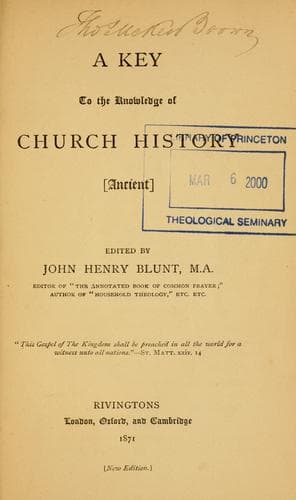
A Key to the Knowledge of Church History (Ancient)Blunt, John Henry
History
A Key to the Knowledge of Church History (Ancient)
Blunt, John Henry
Church history -- Middle Ages, 600-1500; Church history -- Primitive and early church, ca. 30-600
A similar process took place in Asia. Arianism, chiefly in its later
development of Nestorianism, with Eutychianism and other errors, ate
out the heart of the Church, faith grew weak, and love grew cold, and
{121} Mahometanism once more triumphed almost unchecked. Although the
Churches of Asia are not all utterly extinct, yet they share more or
less in the state of ignorance, superstition, and depression which is a
natural consequence of the serious errors with which their profession
of Christianity is intermixed, as well as of the way in which the few
despised Christians are mingled with their richer and more numerous
Mahometan neighbours.
Section 1. _The Church of Italy._
[Sidenote: Lombard kingdom in Italy.]
The kingdom of the Goths in Italy was not of long duration, and their
successors and fellow-Arians, the Lombards, only obtained possession of
the northern portion of the Peninsula, whilst Rome and Southern Italy
became once more subject to the emperors of the East. Gregory the
Great (A.D. 390-A.D. 604) began the work of converting the Lombards to
the Catholic Faith, and in the middle of the seventh century Arianism
had disappeared from Italy. [Sidenote: Renewal of the tie between East
and West.] The renewal of the connexion between the Eastern and Western
Empires, and the attempt of the Emperor Justinian to subject the see of
Rome to that of Constantinople, placed Gregory under the necessity of
vindicating the independence of the Church of Italy, and of denying the
right of any one Patriarch to assume authority over another. St.
Gregory's holiness and learning, and the wisdom of his endeavours to
reform corruptions, were most beneficial to the Church over which he
ruled. [Sidenote: Its rupture.] The Image-breaking Controversy put an
end to the nominal tie between the Eastern emperors and the Church of
Italy (about A.D. 730), and almost the whole {122} of the peninsula
soon after became part of the dominions of Charlemagne. This great
Emperor's influence was used in Italy, as elsewhere, to foster the work
of the Church, which however suffered severely from the state of
lawlessness and confusion incident on the breaking up of Charlemagne's
empire after his death, A.D. 814. [Sidenote: Depression of the Church
in Italy.] The Church of Italy in the ninth century had also to undergo
the inroads of the Mahometans in the South, and of the heathen Magyars
(or Hungarians) on the North, as well as of the Northmen, who ravaged
and pillaged the churches and monasteries on the coasts. Other
depressing influences were to be found in the secularization of the
Bishops of Rome through the increase of their temporal power, and the
usurpation by the German emperors of the right of election to the
popedom, which properly belonged to the Clergy of Rome. [Sidenote:
Gregory VII.'s reforms.] The corruptions which from these and other
causes had crept into the Church of Italy, drew towards them the
Public-domain text, read in full here on John Shaqi.
Reviews
Reviews
No reviews yet
Be the first to share your thoughts on this work.
Elsewhere in the archive
Join the Discussion
Join the discussion
Sign in to leave a comment or review.
Sign InorCreate an account