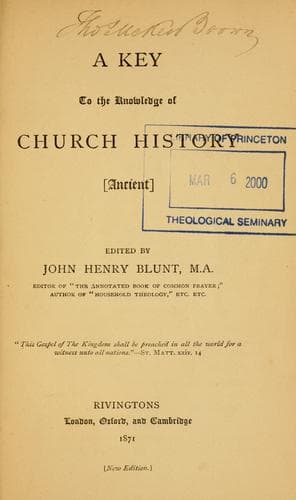
A Key to the Knowledge of Church History (Ancient)Blunt, John Henry
History
A Key to the Knowledge of Church History (Ancient)
Blunt, John Henry
Church history -- Middle Ages, 600-1500; Church history -- Primitive and early church, ca. 30-600
During the reign of Philip IV. (A.D. 1285-A.D. 1314) a collision took
place for the first time, between the Church and Kingdom of France and
the authority of the Pope. Hitherto the disputes between the Popes and
the French monarchs had been on personal rather than on political
grounds, and had given no opportunity for defining the exact limits of
papal authority in France. [Sidenote: Comparative independence of
French Church.] But meanwhile the French Clergy had not lost their
feeling of nationality, and the kings of France had been able to use
much more independent action in the appointment of Bishops than was the
case in other countries. Hence the Bishops and Clergy joined with the
king in resisting the sentence of excommunication pronounced by the
Pope on Philip and his kingdom. Neither King nor Pope appear to have
been influenced by any religious feeling in their contest, and after
the miserable death of Boniface VIII. (A.D. 1303), and the murder of
his successor, Philip's unprincipled interference in the {126} election
of Clement V. was productive of great evils. [Sidenote: Evil results
of the conduct of Philip IV.] The cruel massacre of the Knights
Templars, the corruptions of the Papal Court in France, and more
indirectly the Great Schism in which the Church of France espoused the
cause of the anti-Popes, may all be traced to the conduct of Philip IV.
Section 3. _The Church of Spain and Portugal._
[Sidenote: Conquest of Spain by the Moors.]
Before the end of the sixth century, the Visigoths, who had settled in
what is now Spain and Portugal, had been converted from Arianism to the
Catholic Faith. In A.D. 711 the Mahometan Moors crossed over from
Africa to the South of Spain, and in A.D. 713 all the Peninsula, except
the small mountain district of Asturias, had fallen into their hands.
The more independent and hardy amongst the Spanish Christians took
refuge in this inaccessible portion of the country, whilst others dwelt
amongst the Moors, and appear for a time to have been allowed the
exercise of their religion unmolested by any systematic persecution.
[Sidenote: Persecution of the Spanish Church.] About A.D. 830, however,
the policy of the Moorish conquerors underwent a change, and during the
next hundred years multitudes of Christians in Spain suffered martyrdom
for their faith. [Sidenote: The re-conquest of Spain by the
Spaniards.] After the death of Hachem, the last Caliph of Cordova (A.D.
1031), and the subdivision of his dominions, the Christians of Asturias
succeeded in making head against their oppressors, and gradually won
back from them district after district, until Ferdinand III. (A.D.
1214-A.D. 1252) succeeded in reducing the Moorish possessions to the
single province {127} of Grenada. This last remnant of Mahometan
dominion was wrested from the Moors A.D. 1492, and Spain, as well as
the separate kingdom of Portugal, was once more entirely Christian.
Public-domain text, read in full here on John Shaqi.
Reviews
Reviews
No reviews yet
Be the first to share your thoughts on this work.
Elsewhere in the archive
Join the Discussion
Join the discussion
Sign in to leave a comment or review.
Sign InorCreate an account