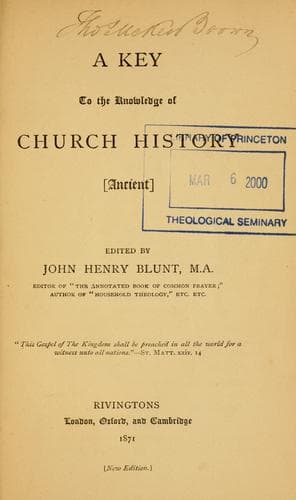
A Key to the Knowledge of Church History (Ancient)Blunt, John Henry
History
A Key to the Knowledge of Church History (Ancient)
Blunt, John Henry
Church history -- Middle Ages, 600-1500; Church history -- Primitive and early church, ca. 30-600
[Sidenote: Effect of national circumstances on Spanish Christianity.]
It is perhaps hardly to be wondered at, that the continual state of
religious warfare in which Spain was so long plunged should have given
a somewhat stern character to Spanish Christianity. The Inquisition,
when introduced into Spain by the mistaken zeal of the good Queen
Isabella towards the end of the fifteenth century, found a readier
welcome than elsewhere, and gained an additional tinge of severity in a
country which had been brought into such close contact with one of the
deadliest forms of unbelief.
[Sidenote: The Spanish Liturgy.]
The original Liturgy of Spain was, like the ancient Liturgy of France,
a form of that used at Ephesus. It received the name of Mozarabic,
from having been in use by Christians living _in the midst of Arabs_,
or Moors, and was not discontinued in the Church of Spain until A.D.
1080, when after much resistance on the part of the Spaniards it was
abolished by order of Alphonso VI., King of Castille and Leon, under
the influence of Pope Gregory VII., and the Roman rite substituted
throughout the country.
Section 4. _The Church of Germany._
[Sidenote: Conversion of Germany by French]
The large tract of country which is now comprehended under the name of
Germany was won to the Church by a long series of missionary labours.
In the beginning of the seventh century Frankish missionaries laid the
foundations of a Church in Bavaria and on the banks of {128} the
Danube, thus paving the way for the conversion of Southern Germany.
[Sidenote: and British missionaries,] Central Germany, then called
Franconia, was the scene of the labours of Kilian, an Irish missionary
(A.D. 630-A.D. 689), whilst the English Bishops Wilfrith (A.D. 677) and
Willebrord (A.D. 692-A.D. 741), preached with much success to the
Frieslanders in the Northwest of Germany, now included in Holland.
[Sidenote: Labours of St. Boniface] It is, however, to a Devonshire
clergyman, Winfrith, better known as St. Boniface (A.D. 715-A.D. 755),
that the title of Apostle of Germany is generally given, not only on
account of his unwearied missionary labours in still heathen districts,
but also on account of his success in organizing and consolidating the
different branches of the German Church. He became Archbishop of
Mentz, and Metropolitan, and at last suffered martyrdom at the hands of
some heathen Frieslanders at the age of seventy-five.
The Emperor Charlemagne endeavoured to compel the rude Saxons in the
neighbourhood of the Baltic to embrace the Christian faith; but
eventually he was induced to trust less to the force of arms for their
conversion, and more to the missionary work of the Church. [Sidenote:
and of Willehad.] Amongst the prominent members of this Saxon mission,
we find another English priest, Willehad, a native of Northumbria,
afterwards Bishop of Bremen, who died A.D. 789.
Public-domain text, read in full here on John Shaqi.
Reviews
Reviews
No reviews yet
Be the first to share your thoughts on this work.
Elsewhere in the archive
Join the Discussion
Join the discussion
Sign in to leave a comment or review.
Sign InorCreate an account