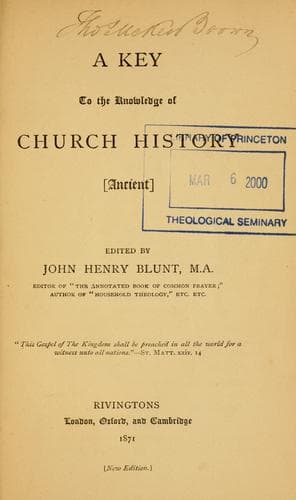
A Key to the Knowledge of Church History (Ancient)Blunt, John Henry
History
A Key to the Knowledge of Church History (Ancient)
Blunt, John Henry
Church history -- Middle Ages, 600-1500; Church history -- Primitive and early church, ca. 30-600
Thus was fulfilled, in one sense at least, the promise of Christ to St.
Peter: "Upon this rock I will build My Church[20];" and he, who first
of the Twelve had faith to confess the Godhead of our Blessed Lord, was
rewarded by being the first to whom it was given to draw men into that
Church, which in His Human Nature Christ had purchased for Himself.
[Sidenote: Further results of St. Peter's sermon.]
In estimating the importance of the results which were brought about by
St. Peter's sermon, we must not only take into account the actual
number of those who were at once added to the disciples, large as that
number was, but we must also remember that many of these converts came
from far distant countries, whither, on their departure from Jerusalem,
they would carry the tidings of the Faith which they had embraced.
Hence they in their turn became forerunners of our Lord and of His
Church, preparing the hearts of those amongst whom they dwelt to listen
to the proclamation of the {11} Gospel, when, in God's appointed
season, it should be preached to them.
Section 3. _The First Beginnings of Persecution._
[Sidenote: A.D. 33. Growth of the Church.]
The Church now steadily grew in influence and numbers; "The Lord added
to the Church daily such as should be" [or "were being"] "saved[21];"
and on the occasion of a second sermon, preached by St. Peter after the
healing of the lame man "at the Beautiful Gate of the Temple," "about
five thousand" were converted[22]. [Sidenote: Beginnings of
persecution.] The opposition of the Jewish rulers was powerless to
check the ever-advancing tide; and this _first beginning of
persecution_, by calling forth from the whole Church an earnest act of
worship and supplication, was the occasion of "great power" and "great
grace" being given to enable her to do and bear all for the sake of her
Lord[23].
[Sidenote: Conversion of St. Barnabas.]
Immediately afterwards we read of the conversion of St. Barnabas, the
first convert mentioned by name, a Levite, and apparently a man of
wealth and position[24]; and then we are told of the awe and reverence
produced in the minds of the people of Jerusalem, and the neighbouring
country, by the abundant exercise of the Apostolic power of working
miracles[25]. [Sidenote: The gift of working miracles.] This great
working gift of the Holy Ghost, bestowed, like the Gift of Tongues, on
the Day of Pentecost, had similar results. Fear was followed by faith,
and {12} "multitudes both of men and women" were added to the Church.
Persecution once more followed, this time with greater severity; the
Apostles were imprisoned through the influence of the sect of the
Sadducees, and, being set free by a miracle, were called before the
Sanhedrim and scourged, only escaping death by the wise and merciful
interposition of the Pharisee Gamaliel.
Section 6. _Worship and Discipline of the Infant Church._
[Sidenote: A.D. 33.]
Public-domain text, read in full here on John Shaqi.
Reviews
Reviews
No reviews yet
Be the first to share your thoughts on this work.
Join the Discussion
Join the discussion
Sign in to leave a comment or review.
Sign InorCreate an account