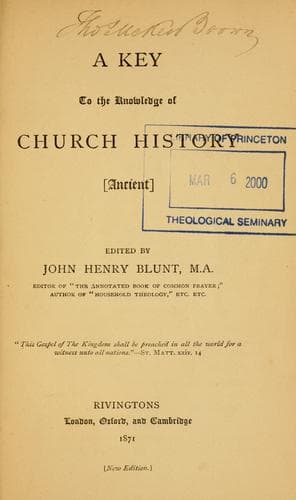
A Key to the Knowledge of Church History (Ancient)Blunt, John Henry
History
A Key to the Knowledge of Church History (Ancient)
Blunt, John Henry
Church history -- Middle Ages, 600-1500; Church history -- Primitive and early church, ca. 30-600
The first attempts to plant the Church in Moravia were made by German
missionaries in the ninth century. [Sidenote: Eastern missionaries in
Moravia] These do not appear, however, to have been very successful,
and about A.D. 860, two Greek monks, Cyril and Methodius, entered upon
the same sphere of labour. Methodius was afterwards consecrated
Metropolitan of Pannonia {129} and Moravia by the Pope; but there was
considerable jealousy on the part of the Latinized Germans towards
their Eastern fellow-labourers, and eventually the Moravian Church was
subjected to the Bishops of Bohemia.
[Sidenote: and Bohemia.]
The first Christian Duke of Bohemia was converted about A.D. 871,
whilst staying at the Moravian court, probably by Methodius; but the
Church made very slow progress in Bohemia until after the conquest of
that country by Otho the Great (A.D. 950), and the foundation of the
Bishopric of Prague by King Boleslav the Pious (A.D. 967-A.D. 999). In
Bohemia, as well as in Moravia, the influence of the Greek missionaries
made itself felt in the impress it left upon the ritual and usages of
the two Churches, especially in the fact that the native Sclavonic
language was used in Divine Worship; but in the end German influences
prevailed in both countries, and the national "use" gradually made way
for the Latinized ritual common in Germany.
[Sidenote: Conversion of North Prussia,]
Until towards the middle of the tenth century, the Church made but very
small progress in the northern portion of what is now the kingdom of
Prussia. These regions were then occupied by a Sclavonic race called
Wends, who yielded an unwilling submission to the Western emperors, and
disliked Christianity as being the religion of their conquerors.
Between A.D. 964 and A.D. 968, several bishoprics were founded in this
country by Otho the Great, and amongst them the metropolitan see of
Magdeburg. A revolt of the Wends frustrated for the time the success
of the emperor's plans, but in the next century Gottschalk, who became
king of the Wends A.D. 1047, and was himself a Christian, did all in
his {130} power to aid the missionary work of the Church among his
people. He was martyred by his subjects, A.D. 1066, and heathenism
triumphed once more. During the twelfth century, the Wendish kingdom
was dissolved, and its territories divided amongst different German
princes, after which the Church gradually regained and extended its
hold on the country. The northern Wends, who obstinately adhered to
their Pagan superstitions, were at last converted chiefly by the
labours of St. Vicelin, who became Bishop of Oldenburg, A.D. 1148.
[Sidenote: of Pomerania,]
Public-domain text, read in full here on John Shaqi.
Reviews
Reviews
No reviews yet
Be the first to share your thoughts on this work.
Elsewhere in the archive
Join the Discussion
Join the discussion
Sign in to leave a comment or review.
Sign InorCreate an account