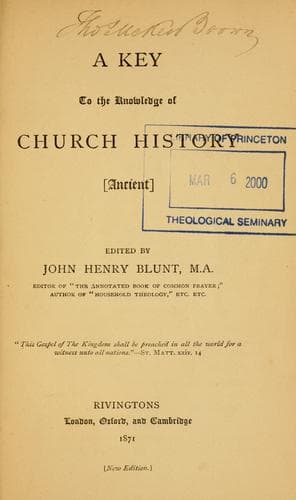
A Key to the Knowledge of Church History (Ancient)Blunt, John Henry
History
A Key to the Knowledge of Church History (Ancient)
Blunt, John Henry
Church history -- Middle Ages, 600-1500; Church history -- Primitive and early church, ca. 30-600
The Church of Russia, as it now exists, owes its foundation chiefly to
Greek Missionaries, who began their labours about A.D. 866, amongst the
tribes bordering on the dominions of the Eastern Empire. Before the
middle of the next century Christianity had gained a footing in the
ancient capital of Kiev, and about A.D. 933 the Princess Olga was
baptized at {140} Constantinople. [Sidenote: It flourishes under
Vladimir.] In the reign of her grandson, Vladimir (A.D. 986-A.D. 1014),
the Church made great progress in Russia. Vladimir made a public
recognition of Christianity, and by his marriage with the sister of the
Greek Emperor strengthened the links which bound Russia to
Constantinople. The Greek missionaries were aided in their labours,
churches and bishoprics were founded, and the Holy Scriptures and
Service Books translated into the native Sclavonic language; the Greek
monks, Cyril and Methodius, who have been already mentioned as
instrumental in the conversion of Bohemia and Moravia, taking also an
active share in the Christianizing of Russia. [Sidenote: Independence
of the Russian Church,] In the reigns of Yaroslav and his successor
(A.D. 1019-A.D. 1077), the empire became completely Christian, and the
Church of Russia was placed on an independent footing, with a native
primate at its head. Innocent III. (A.D. 1198-A.D. 1216) attempted to
win over Russia to the Roman communion, by offering to confer the title
of King on Prince Roman, but his offer was at once rejected.
[Sidenote: which it has steadily refused to give up,] Russia suffered
severely from the ravages of the Mongul Tartars, A.D. 1223, and Pope
Innocent IV. took advantage of the distressed condition of the Russian
church and the removal of the Greek Patriarchate from Constantinople to
Nicaea, to make another attempt at detaching Russia from communion with
the Greeks. David, Prince of Galicia, professed himself willing to
receive the crown and title of king from Rome, but this arrangement was
not of long duration, and about A.D. 1230 a Metropolitan of the Russian
Church was consecrated by the Greek Patriarch, to fill up the vacancy
which had taken place {141} ten years before during the Tartar
invasion. Kiev, the original seat of the Russian Patriarchate, was
burnt and pillaged by the Tartars, and the see was transferred to
Vladimir, A.D. 1299, and thence during the early part of the next
century (A.D. 1320) to Moscow, where it has since remained.
[Sidenote: and has preserved unbroken.]
For more than two centuries, until A.D. 1462, Russia was oppressed by
the yoke of the unbelieving Tartars, but the Church still maintained
her independence, and steadily resisted the various attempts which were
made to bring about a reunion between East and West, by the subjugation
of the former to the unjust claims of the latter.
Public-domain text, read in full here on John Shaqi.
Reviews
Reviews
No reviews yet
Be the first to share your thoughts on this work.
Elsewhere in the archive
Join the Discussion
Join the discussion
Sign in to leave a comment or review.
Sign InorCreate an account