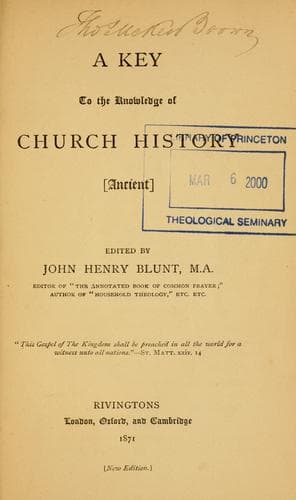
A Key to the Knowledge of Church History (Ancient)Blunt, John Henry
History
A Key to the Knowledge of Church History (Ancient)
Blunt, John Henry
Church history -- Middle Ages, 600-1500; Church history -- Primitive and early church, ca. 30-600
[1] The preaching Friars having been in vain employed for the
conversion of the Albigenses, their efforts were supplemented by the
institution of the Inquisition.
{142}
CHAPTER XII
The Mediaeval Church in Great Britain and Ireland
A.D. 500-A.D. 1500
Section 1. _The Church of England._
[Sidenote: Trials of the English Church under the Saxons.]
We have seen (p. 74) that the native Church of England had not
succeeded in converting the Anglo-Saxon invaders who gradually took
possession of the country, and that such as remained of the Bishops and
Clergy had been compelled for the most part to take refuge in
mountainous, and therefore inaccessible, districts. It was, however,
only in A.D. 587, that Theonas, Bishop of London, and Thadiocus, Bishop
of York, retreated from their sees, and they were both living in exile
in Wales, when, ten years later, St. Augustine was sent by Pope Gregory
to found a mission in England.
[Sidenote: Roman usurpation.]
It seems uncertain whether St. Gregory was aware of the previous
existence of a Church in these islands; at any rate, he acted as if
ignorant of the fact, by bestowing on St. Augustine a spiritual
supremacy over the whole country; and the good Italian missionary, when
brought into actual contact with the living representatives of a
national Church already five hundred years old, appears to have
considered himself justified in endeavouring to bring its {143} Liturgy
and usages into agreement with the Roman pattern. [Sidenote:
Consequent disputes.] All this was not unnatural, especially under the
circumstances of weakness and depression in which the Church of England
was then placed; but it was equally natural that such interference
should be felt to be an usurpation, and resented accordingly, and that
much misunderstanding and bitterness should be the consequence. There
probably was a recognition of the claims of the elder race of English
Bishops in the fact, that St. Augustine was consecrated to the see of
Canterbury rather than to that of London, of which the rightful
occupant was still living, and that neither the latter diocese, nor
that of York, appear to have been filled up until after the deaths of
Theonas and Thadiocus. [Sidenote: English independence partially
recognized.] It was also eventually found expedient to leave to the
English Church its own national Liturgy and ritual (originally derived
through a Gallican channel from that of Ephesus), instead of insisting
upon an exact conformity to Roman rites. [Sidenote: Some account of
the English Liturgy.] This ancient English Liturgy, revised in the
seventh century by St. Augustine, underwent a second revision at the
hands of Osmund, Bishop of Salisbury, about A.D. 1083; and, though
certain variations existed in some dioceses, the "Use of Sarum," as it
was called, became the general "use" throughout the southern portion of
England, and was even at length considered to be _the_ Liturgy of the
country.
Public-domain text, read in full here on John Shaqi.
Reviews
Reviews
No reviews yet
Be the first to share your thoughts on this work.
Elsewhere in the archive
Join the Discussion
Join the discussion
Sign in to leave a comment or review.
Sign InorCreate an account