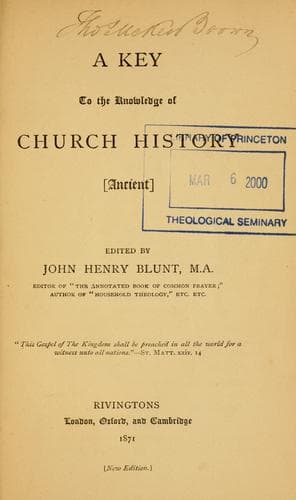
A Key to the Knowledge of Church History (Ancient)Blunt, John Henry
History
A Key to the Knowledge of Church History (Ancient)
Blunt, John Henry
Church history -- Middle Ages, 600-1500; Church history -- Primitive and early church, ca. 30-600
The appointment of foreigners to the highest ecclesiastical offices in
England, was one means by which the Norman sovereigns sought to secure
themselves against disaffection amongst their new subjects; but the
real result of this policy was to foster the claims of the Popes to
religious and secular supremacy in this country; for these foreign
ecclesiastics, though English Bishops, were not loyal subjects of the
English crown, nor were their interests identical with those of their
flocks. [Sidenote: Lanfranc.] Thus the Italian Lanfranc, when
appointed Archbishop of Canterbury by William the Conqueror (A.D.
1070), did not hesitate to obey the summons of the Pope to Rome for the
purpose of receiving the pall, and thus acknowledging that he held his
Bishopric from the Papal see. [Sidenote: St. Anselm.] His successor,
St. Anselm (A.D. 1093), also an Italian, and a man of great learning
and holiness, was prepared to carry out a similar line of conduct; but
the covetous and irreligious tyrant, William Rufus, was seeking at
{147} the same time to reduce Bishops to the state of mere nominees and
vassals of the crown, and a long contest ensued[2]. The dispute was
carried on into the next reign; and at length, in A.D. 1107, a
compromise was agreed upon, by which it was arranged that Bishops
should receive investiture from the Pope, and, at the same time, take
an oath of allegiance to the king. [Sidenote: St. Thomas of
Canterbury.] Anselm's unflinching advocacy of Papal claims cost him
years of exile from his diocese, and much suffering; but, in the
following century, similar conduct involved still more serious
consequences to St. Thomas a Becket, the then Archbishop of Canterbury.
The new question in dispute was the right of clerical offenders to be
tried in the spiritual courts, instead of coming under the jurisdiction
of the civil power; but, in reality, it was only another form of the
constant endeavours of the English monarchs to free themselves from the
foreign bondage which was, to some extent at least, self-imposed.
Becket fell a martyr to his own sense of duty and the king's
displeasure, A.D. 1170.
[Sidenote: Roman influence strongest in England.]
Papal usurpation in England reached its height when, in A.D. 1208,
Innocent III placed the kingdom under an Interdict, for refusing to
receive as Archbishop of Canterbury his nominee, Stephen Langton, who
was unacceptable both to king and people; and soon after proceeded to
excommunicate John, and depose him from his throne. The king's
cowardly and unconstitutional conduct in resigning his kingdom into the
{148} hands of the Pope's legate (A.D. 1213), and receiving it again at
the end of three days as a tributary vassal of the Roman see, caused
England to be looked upon for some years as only a fief of Rome.
[Sidenote: Kept up by the Friars;]
Public-domain text, read in full here on John Shaqi.
Reviews
Reviews
No reviews yet
Be the first to share your thoughts on this work.
Elsewhere in the archive
Join the Discussion
Join the discussion
Sign in to leave a comment or review.
Sign InorCreate an account