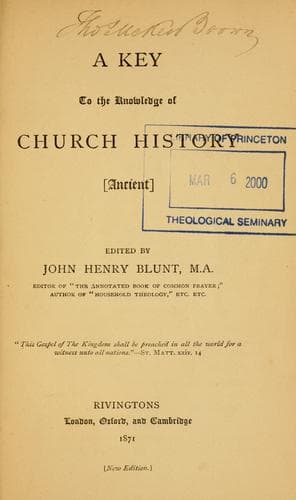
A Key to the Knowledge of Church History (Ancient)Blunt, John Henry
History
A Key to the Knowledge of Church History (Ancient)
Blunt, John Henry
Church history -- Middle Ages, 600-1500; Church history -- Primitive and early church, ca. 30-600
Alfred was very zealous in his endeavours to repair the spiritual and
intellectual losses which the Church of England had undergone during
the contest with the Danes, whose ravages had almost entirely swept
away all native scholarship. The king was especially eager to secure a
literature in the vernacular for his subjects, and himself translated
into "simple English" parts of the Holy Bible, and other religious
books. In these labours he was assisted by a small body of learned
men, including the two Aelfrics, Archbishops of Canterbury and York,
and Wulfstan, supposed to have been Bishop of Worcester. The
conversion of the Danes who had first settled in England to
Christianity prepared the way for the evangelizing of later colonists;
and when, through the crimes and weakness of the later Anglo-Saxon
princes, the country fell altogether into the hands of Danish invaders,
Canute the Great (A.D. 1016-A.D. 1033) not only embraced Christianity
himself, but secured for his native country the services of English
missionaries. [Sidenote: Evangelization of Scandinavia.] In fact, at
this time Scandinavia seems to have been the chief mission-field of the
English Church.
[Sidenote: Roman influence comparatively small under the Saxons.]
We can hardly be wrong in gathering from all this, that Roman influence
had only to a certain limited extent been introduced into the Church of
England by St. Augustine's mission, and that, as time passed on, the
foreign element had become absorbed in the national one. With the
Norman conquest of A.D. 1066, the {146} case was, however, altered.
[Sidenote: Much increased under the Normans.] The claims of the Popes
to temporal as well as to spiritual authority were by that time
definite and authoritative; the Conquest itself had been undertaken by
the permission of Alexander II., and the authority of the foreign
conquerors, (as the Norman and early Plantagenet kings continued to
be,) required foreign support. Hence the Bishops of Rome gained an
amount of political influence in England which was thoroughly
unconstitutional, and which could probably never have been attained by
any foreign power, had the English sovereigns immediately after the
Conquest felt themselves more firmly fixed upon the throne they had
seized.
[Sidenote: Denationalizing of the Episcopate.]
Public-domain text, read in full here on John Shaqi.
Reviews
Reviews
No reviews yet
Be the first to share your thoughts on this work.
Elsewhere in the archive
Join the Discussion
Join the discussion
Sign in to leave a comment or review.
Sign InorCreate an account