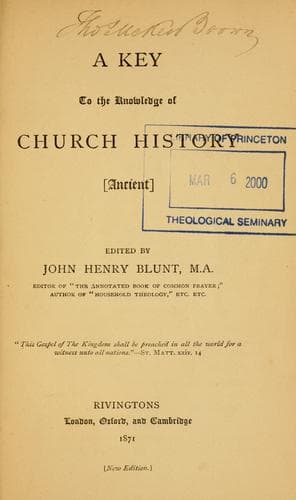
A Key to the Knowledge of Church History (Ancient)Blunt, John Henry
History
A Key to the Knowledge of Church History (Ancient)
Blunt, John Henry
Church history -- Middle Ages, 600-1500; Church history -- Primitive and early church, ca. 30-600
It is not to be supposed that these encroachments of a foreign power
were accepted without a murmur or remonstrance on the part of the
people of England; on the contrary, there was a constant undercurrent
of discontent, which found occasional expression in some official or
popular protest. Such, on the one hand, was the statute of
_praemunire_, passed in the reign of Richard II. (A.D. 1389), to
prohibit Papal interference with Church patronage and decisions in
ecclesiastical causes; and, on the other, the irregular proceedings of
Wickliffe and the Lollards, in the fourteenth and fifteenth centuries,
which, though they eventually degenerated into seditious agitation, had
their rise in a feeling of opposition to Romish abuses and usurpations.
This feeling was increased by the fearful state of profligacy into
which Rome, and indeed all Italy, was plunged during the fifteenth
century, which effectually destroyed the character formerly enjoyed by
the Roman Church, whilst it could not but affect the spiritual health
of the other Churches over which Rome exercised so wide an influence.
Wiser and calmer men than Wickliffe saw the need of some reformation,
though they questioned, and, as the event showed, rightly, the wisdom
and the justice of the steps he took towards his object. Wickliffe's
teaching in the fourteenth century had, in fact, little or nothing to
do with the real Reformation of two hundred years later, except that
some of his dangerous theories on political matters took deeper root
than did his {150} religious peculiarities, and bore fruit in much of
the unprincipled licence which was an unhappy, though by no means an
essential, feature of the Reformation era.
[Sidenote: English longings for reformation.]
England, in common with the other nations of Europe, was willing to
hope for great benefit from the councils of the Church held in the
fifteenth century; and, at each of them, we find English Clergy making
grave and urgent protests against the abuses which they saw around
them, and pleading for a return to purer and better ways. Thus, at the
Council of Pisa, A.D. 1400, one of the English Bishops who attended it
presented a memorial which complained of the evils resulting from the
want of episcopal control over the monasteries, from the practice of
appeals to Rome, and from the ease with which dispensations for
non-residence and pluralities were obtained[3]. Again, at the Council
of Constance (A.D. 1415) a sermon was preached by Dr. Abendon, an
Oxford professor, which painted in very strong language the worldliness
and covetousness of the non-resident Bishops and Clergy; and these
protests were followed up by an official appeal to the Pope for a
reformation, on the part of the Kings of France and England, A.D. 1425,
as well as by official instructions given to the English deputation
despatched to the Council of Basle (A.D. 1431), to use their influence
for the same end.
{151}
Section 2. _The Church of Ireland._
Public-domain text, read in full here on John Shaqi.
Reviews
Reviews
No reviews yet
Be the first to share your thoughts on this work.
Elsewhere in the archive
Join the Discussion
Join the discussion
Sign in to leave a comment or review.
Sign InorCreate an account