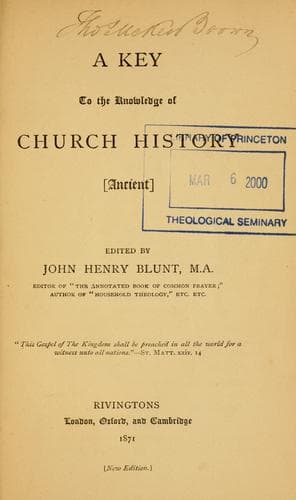
A Key to the Knowledge of Church History (Ancient)Blunt, John Henry
History
A Key to the Knowledge of Church History (Ancient)
Blunt, John Henry
Church history -- Middle Ages, 600-1500; Church history -- Primitive and early church, ca. 30-600
The Church of Ireland was not, like the Church of Great Britain, to
which it owes its foundation, a prey to the depressing influences of
the heathen Saxons; and, at the time of the mission of St. Augustine,
the daughter was in some measure enabled to repay to the mother the
benefits which the British St. Patrick had conferred on the scene of
his missionary labours. A constant intercourse was kept up between the
numerous monasteries of Ireland and those of Wales and Scotland, some
of the abbeys in the latter countries being founded and frequented by
Irishmen. [Sidenote: Early reputation of Ireland.] Ireland, in the
sixth and seventh centuries, had a great reputation for learning and
missionary zeal, both of which were called into play to help in the
reconversion of a large portion of England, as well as to encourage the
efforts of English Churchmen in retaining in the National Church the
national characteristics, with the loss of which it was threatened from
the large admixture of foreign elements introduced by St. Augustine.
[Sidenote: Irish missionary work in England and elsewhere.] Nor were
their missionary labours confined to England: they shared in the toils
and honours of the conversion of Germany, and are believed to have
penetrated as far as Iceland and Greenland. [Sidenote: Unjustifiable
conduct of England.] The aid given by Irish ecclesiastics in preserving
the religious liberty of the Church of England was ill requited in the
twelfth century, when the English, having taken possession of Ireland,
forced the Irish Church to abandon her distinctive Liturgy by a decree
passed at the synod of Cashel, A.D. 1173. The state of anarchy and
restless discontent into which {152} Ireland was thrown by the presence
of English invaders, had a very unfavourable effect on the Church of
the country, as had also the appointment of Englishmen to Irish
bishoprics, and the consequent non-residence of the Bishops. It is
curious that the influence of English conquerors should have tended to
extend Roman authority in Ireland, much as the policy of Norman
conquerors produced the same effect in England. Before the
Reformation, the state of the Irish Church had become thoroughly
unsatisfactory, and was felt to be so by many of the Irish themselves.
Section 3. _The Church of Scotland._
[Sidenote: St. Columba.]
Public-domain text, read in full here on John Shaqi.
Reviews
Reviews
No reviews yet
Be the first to share your thoughts on this work.
Elsewhere in the archive
Join the Discussion
Join the discussion
Sign in to leave a comment or review.
Sign InorCreate an account