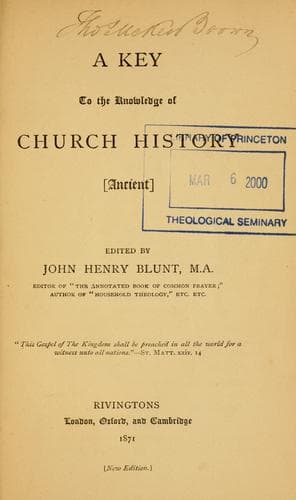
A Key to the Knowledge of Church History (Ancient)Blunt, John Henry
History
A Key to the Knowledge of Church History (Ancient)
Blunt, John Henry
Church history -- Middle Ages, 600-1500; Church history -- Primitive and early church, ca. 30-600
The country of the Southern Picts, christianized by St. Ninian (see p.
76), having fallen into the hands of the heathen Anglo-Saxons,
something like a fresh evangelization became necessary; and this was
accomplished by the labours of St. Columba and his successors, who,
having crossed over from Ireland (first about A.D. 560) for the purpose
of preaching to the Northern tribes of Scotland, extended their mission
southward. [Sidenote: Irish or Scotch missionaries in England.] The
monastery of Iona, or Icolmkill, was for some time inhabited by Irish
missionaries, and became the chief source of missionary labour not only
in Scotland, but also in the North of England, the Scotch or Irish
missionaries using all the weight of their influence to uphold the
independence of the National Church against the Roman tendencies of St.
Augustine and his successors. St. Aidan (died A.D. 651), Bishop of
Lindisfarne, or Holy Island, and the head of the mission for the
conversion of the Saxon kingdom of Mercia, was a monk of Iona. His
diocese included {153} Yorkshire, and extended to Scotland; and, in
consequence of this, the Archbishops of York long laid claim to
exercise metropolitan authority over the whole of North Britain.
Roman influence gradually made itself felt in Scotland, in great
measure through the monastic system, which received a great impetus
under David I. (A.D. 1124-A.D. 1153). [Sidenote: Longings for
reformation.] The constant wars with England, and the confusion and
bloodshed they entailed, had a very unfavourable effect on the
prosperity and spiritual activity of the Church of Scotland, so that
from Scotland, no less than from England and Ireland, there arose that
cry for a return to older and purer ways, which ended in the
Reformation.
[1] The native Clergy seem to have laboured chiefly in the north, where
they were aided by Scotch and Irish missionaries. St. Aidan, Bishop of
Lindisfarne, or Holy Island (who died A.D. 651), may be mentioned as a
successful agent in the conversion of Northumbria and Mercia.
[2] This dispute between St. Anselm and the English king was another
form of the long strife between the Popes and the Emperors of the West,
which is known as the War of Investitures.
[3] Many of the Bishops, at this time, were foreigners, who lived away
from their sees, and did not even understand the native language of
their flocks. The Kings of England and the Bishops of Rome seem to
have equally abused their powers of patronage in this respect.
{155}
INDEX
Public-domain text, read in full here on John Shaqi.
Reviews
Reviews
No reviews yet
Be the first to share your thoughts on this work.
Elsewhere in the archive
Join the Discussion
Join the discussion
Sign in to leave a comment or review.
Sign InorCreate an account