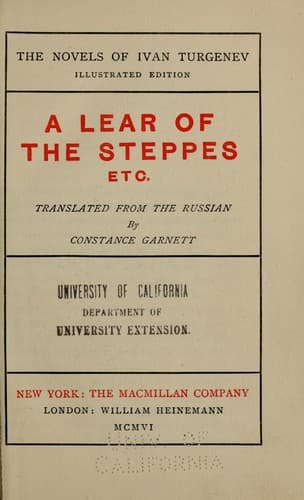
A Lear of the Steppes, etc.Turgenev, Ivan Sergeevich
General
A Lear of the Steppes, etc.
Turgenev, Ivan Sergeevich
Russia -- Social life and customs -- Fiction; Turgenev, Ivan Sergeevich, 1818-1883 -- Translations into English
‘My father was very kind, clever, cultivated, and unhappy. Fate treated
him no worse than others; but he could not get over her first blow. He
married early, for love; his wife, my mother, died very soon after; I
was only six months old then. My father took me away with him to his
country place, and for twelve years he never went out anywhere. He
looked after my education himself, and would never have parted with me,
if his brother, my uncle, had not come to see us in the country. This
uncle always lived in Petersburg, where he held a very important post.
He persuaded my father to put me in his charge, as my father would not
on any consideration agree to leave the country. My uncle represented
to him that it was bad for a boy of my age to live in complete
solitude, that with such a constantly depressed and taciturn instructor
as my father I should infallibly be much behind other boys of my age in
education, and that my character even might very possibly suffer. My
father resisted his brother’s counsels a long while, but he gave way
at last. I cried at parting from my father; I loved him, though I had
never seen a smile on his face … but when I got to Petersburg, I soon
forgot our dark and cheerless home. I entered a cadet’s school, and
from school passed on into a regiment of the Guards. Every year I used
to go home to the country for a few weeks, and every year I found my
father more and more low-spirited, absorbed in himself, depressed, and
even timorous. He used to go to church every day, and had quite got out
of the way of talking. On one of my visits--I was about twenty then--I
saw for the first time in our house a thin, dark-eyed little girl of
ten years old--Acia. My father told me she was an orphan whom he had
kept out of charity--that was his very expression. I paid no particular
attention to her; she was shy, quick in her movements, and silent as
a little wild animal, and directly I went into my father’s favourite
room--an immense gloomy apartment, where my mother had died, and where
candles were kept burning even in the daytime--she would hide at once
behind his big arm-chair, or behind the book-case. It so happened
that for three or four years after that visit the duties of the
service prevented my going home to the country. I used to get a short
letter from my father every month; Acia he rarely mentioned, and only
incidentally. He was over fifty, but he seemed still young. Imagine my
horror; all of a sudden, suspecting nothing, I received a letter from
the steward, in which he informed me my father was dangerously ill,
and begged me to come as soon as possible if I wanted to take leave of
him. I galloped off post-haste, and found my father still alive, but
almost at his last gasp. He was greatly relieved to see me, clasped me
in his wasted arms, and gazed at me with a long, half-scrutinising,
half-imploring look, and making me promise I would carry out his last
request, he told his old valet to bring Acia. The old man brought her
Public-domain text, read in full here on John Shaqi.
Reviews
Reviews
No reviews yet
Be the first to share your thoughts on this work.
Elsewhere in the archive
Join the Discussion
Join the discussion
Sign in to leave a comment or review.
Sign InorCreate an account