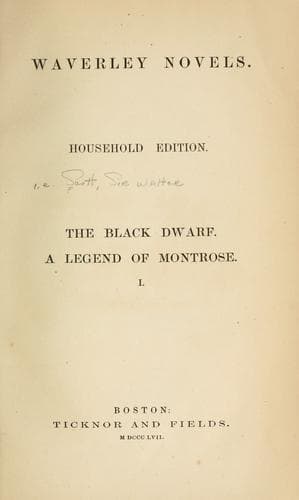
Historical fiction; Montrose, James Graham, Marquis of, 1612-1650 -- Fiction; Scotland -- History -- Charles I, 1625-1649 -- Fiction
“Saxon,” said the dying man, “speak to me no more of thy priest--I die
contented. Hadst thou ever an enemy against whom weapons were of no
avail--whom the ball missed, and against whom the arrow shivered, and
whose bare skin was as impenetrable to sword and dirk as thy steel
garment--Heardst thou ever of such a foe?”
“Very frequently, when I served in Germany,” replied Sir Dugald. “There
was such a fellow at Ingolstadt; he was proof both against lead and
steel. The soldiers killed him with the buts of their muskets.”
“This impassible foe,” said Ranald, without regarding the Major’s
interruption, “who has the blood dearest to me upon his hands--to this
man I have now bequeathed agony of mind, jealousy, despair, and sudden
death,--or a life more miserable than death itself. Such shall be the
lot of Allan of the Red-hand, when he learns that Annot weds Menteith
and I ask no more than the certainty that it is so, to sweeten my own
bloody end by his hand.”
“If that be the case,” said the Major, “there’s no more to be said; but
I shall take care as few people see you as possible, for I cannot
think your mode of departure can be at all creditable or exemplary to
a Christian army.” So saying, he left the apartment, and the Son of the
Mist soon after breathed his last.
Menteith, in the meanwhile, leaving the new-found relations to their
mutual feelings of mingled emotion, was eagerly discussing with Montrose
the consequences of this discovery. “I should now see,” said the
Marquis, “even had I not before observed it, that your interest in
this discovery, my dear Menteith, has no small reference to your own
happiness. You love this new-found lady,--your affection is returned. In
point of birth, no exceptions can be made; in every other respect,
her advantages are equal to those which you yourself possess--think,
however, a moment. Sir Duncan is a fanatic--Presbyterian, at least--in
arms against the King; he is only with us in the quality of a prisoner,
and we are, I fear, but at the commencement of a long civil war. Is this
a time, think you, Menteith, for you to make proposals for his heiress?
Or what chance is there that he will now listen to it?”
Passion, an ingenious, as well as an eloquent advocate, supplied the
young nobleman with a thousand answers to these objections. He reminded
Montrose that the Knight of Ardenvohr was neither a bigot in politics
nor religion. He urged his own known and proved zeal for the royal
cause, and hinted that its influence might be extended and strengthened
by his wedding the heiress of Ardenvohr. He pleaded the dangerous state
of Sir Duncan’s wound, the risk which must be run by suffering the young
lady to be carried into the country of the Campbells, where, in case of
her father’s death, or continued indisposition, she must necessarily
be placed under the guardianship of Argyle, an event fatal to his
(Menteith’s) hopes, unless he could stoop to purchase his favour by
abandoning the King’s party.
Public-domain text, read in full here on John Shaqi.
Reviews
Reviews
No reviews yet
Be the first to share your thoughts on this work.
Elsewhere in the archive
Join the Discussion
Join the discussion
Sign in to leave a comment or review.
Sign InorCreate an account